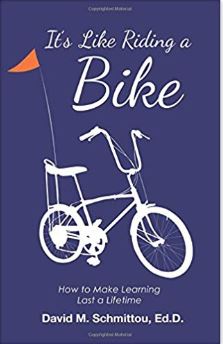
In 2017 my first book on educational methods, titled It’s Like Riding a Bike-How to make learning last a lifetime, was published. With more than 10,000 copies printed, I decided that now is the time to share my thoughts with the world for FREE.
Over ten weeks in the summer/fall of 2023 a chapter of the book will be shared each week via this blog. Feel free to read in any order that works for you. Feel free to bookmark entries to read all at once at a later date. Feel free to share with others. Feel free to disagree with anything you read or to scream your affirmations from the mountain tops. This is for YOU. This is for our kids. This is how we teach so that it lasts a lifetime.
Introduction- Let’s think about it differently
We live in an amazing time, a time of innovation, a time of growth, a time of opportunity. We tell our children from the time they enter school that they can do and become anything they want if they simply work hard. I have traveled around the globe and I can tell you that in virtually every corner of the world, people are evolving at a rapid pace. As an educator, one of my charges is to try and keep it that way. I am tasked with helping to prepare our young people to keep dreaming. To keep innovation alive and to keep our businesses prospering. The problem is that this is becoming increasingly more difficult. This isn’t really because we aren’t doing things right. It’s just that, here in North America, we are not doing all we can, and others around the world, those with seemingly nothing to lose by trying to do things differently, are quickly catching up and in many instances, passing us by.
Some are arguing, quite persuasively I might add, that we need to put an even bigger emphasis on reading, commonly incorrectly titled “literacy’. It has been said that the more a student reads, the more he will learn. But, what if this is not actually true. In spite of mandates from every state, territory, province, and municipality proclaiming the need to explicitly teach reading to help our students become lifelong learners, for some reason, we just don’t seem to be making the headway we hope for. It’s possible that we are just missing the mark in implementation of the mandates or maybe, just maybe, we have it all wrong.
I am an avid reader. Each night, I climb into bed with a book in hand and process my day through the lens of the written word. My dining room walls are covered by bookshelves displaying all of the books I have read and the countless others still on my “to-do list.” Teachers at my school where I work often come to me for advice and leave with a book in their hand that I have pulled from yet another shelf because I feel it has just the answers they are looking for. Even with that I am comfortable saying, “I don’t care if my kids choose to read”.
That’s a pretty big statement for a father of four, former classroom teacher, middle school principal, elementary school principal, Curriculum Director, and college professor with a Doctorate in Education, to make, but do I really mean it? I sure do. I mean it in regard to my own biological children and I mean it in regard to the children I am asked to educate in my school. I know the dangers of being a professional educator, living in America making such a statement, but I don’t care if my kids read. That’s crazy talk, to many, I know.
Does this mean I don’t care about their futures, that I do not want to see my children succeed, learn, and thrive? After all, everyone will tell you that to be productive today you must be able to read. That is true, however, where I think we have missed the mark is seeing reading as an endpoint, a goal, as opposed to a tool. Perhaps we need to start using reading as a method to secure more learning instead of a method that we are going to assess. Instead of stating that students who read more, learn more, perhaps we can start stating that students who learn more, read more. A slight change in word order can have profound changes to what we do. Reading is indeed a way that students can learn, however, it is not THE way.
Reading is a skillset students can use to acquire more knowledge, but it is not the only way. Only when we begin to understand this can we begin to see the difference in student achievement that we are all after.
We need to begin to change the conversation. My goal is to make educators and politicians stop and question what it is we are ultimately after and investigate new ways to achieve those goals, and the truth is, I honestly believe we may have drifted off of course by focusing so much on reading as the primary form of literacy, as opposed to what it really is: the way most of us acquired literate skills before the days of Google, YouTube, Twitter, Instagram, and Facebook.
Many of us have been exposed to social studies lessons on the Protestant Reformation which occurred during the 16th century. During this time, approximately 500 years ago, religious leaders in Europe found themselves at a crossroads. Reformers like Martin Luther and John Calvin found themselves in the middle of controversy, and now in the heart of history books, because of their radical beliefs. The basic premise of their “radical” beliefs was that the common man should be able to learn to read in order to be able to interpret religious texts without the aid of the Catholic Church and its verbal interpretations. This belief, that the common man should be allowed to read, was so radical that it spawned wars, persecution, and the establishment of new worldwide religions. The spread of ideas through the skill of reading has been a key foundation of learning ever since.
In America, during the early 20th century, propaganda was often spread using written pamphlets advertising the need for social and political unions and associations; during world wars advertising campaigns were inspired and recruitment drives centered around a well-written narrative. For the past 100 years, many Americans have started their mornings by enjoying a cup of coffee and reading the USA Today, New York Times, or their local newspaper. Reading has been instrumental in the spread of ideas and key to learning for hundreds of years for millions of people so how can I say that I don’t care if my kids can read? How will they ever be able to be informed, productive, self-driven leaders if they do not learn how to read? I am glad you asked.
The world today
According to Forbes Magazine, at the time this text is being written, the four largest publicly traded businesses in the world are based in China. Based on this, as a father of four kids, if I want my children to be successful in this new world, should I be teaching them to read and speak in Chinese? Helping them learn to speak the native language of the four largest corporations in the world would surely give them a competitive advantage in securing a job. But, despite this, learning Chinese is not a common practice in America. Maybe I shouldn’t worry about the flattening of the world, as described by Thomas Friedman in his 2005 text, and should just worry about preparing my children for their success in America and getting them to learn how to read English text. Maybe I should discount the fact that in America, where me and my kids live, over the last 25 years, the number of Spanish speakers and readers has nearly tripled from approximately 5% of the population to close to 14%. Or perhaps I should discount the fact that YouTube, the world’s second most popular website averages 1,000,000 unique visitors every month, while the third most popular site, Facebook is close behind at 900,000 and that these sites do not focus on written text, but instead they rely on visual media such as photographs and videos. Perhaps I should ignore the fact that state and federal authorities have increasingly reduced written text in street and traffic signs and tax return documents, to ensure equity and reduce costs. Maybe it is inconsequential that sites like Twitter force users to consolidate their thoughts to 280 characters or less, while others such as Instagram and Pinterest force users to communicate with visual imagery at the expense of the written word.
We live in an ever-evolving time, a time of mass communication and social media, a time of global competition and melting pot societies. We live in an age when information is readily available via the internet and cable news. We live in a time when children learn to “text” (used as a verb not a noun) with improper grammar and are still able to communicate well enough to get their ideas across to each other. We live in an age when speech-to-text, Siri, Alexa, and artificial intelligence can share audibly what just a few years ago required visual decoding. Five hundred years ago Martin Luther became an advocate for men to be able to read to allow individuals to be able to acquire information and interpret it freely and independent of undue influence. Today our children are afforded more information than they can ever hope to absorb; the question is can they do anything with it. Have we become so focused on teaching our students how to gain fluency and decoding skills in written form that we have sacrificed their ability to analyze, synthesize, and evaluate information in all mediums?
Reading is only one way we can collect information. I want my children to be able to acquire information from several different sources, to be able to identify which source provides them with the most accurate and useful information, and then more importantly figure out what to do with it all. I want my kids doing things to learn things, because ultimately when they are adults, they will be measured by what they do, not just what they know.
Most of us have heard the statement, “Once you learn how to ride a bike, you never forget.” As a career educator I have often wondered why the saying isn’t, “Once you learn Algebra, or grammar, or even something as mundane as the colors of the rainbow, you never forget.” Instead, the saying wraps around a skill that is much more complex to master than memorizing a formula or frequently observed colors. Why is it that many of us today have such a difficult time remembering much of anything we learned when being provided explicit instruction in school, yet I believe all of us can testify to the fact that we do indeed still remember how to ride our bikes even though most of us got our initial guidance when we were five or six years old? Surely, it is not because the task is easy, because it is anything but that. As a matter of fact, if I asked you to describe everything you have to do to effectively ride a bike, a skill you are able to perform probably with relative ease, you may struggle. This is not only due to the complexity of the skill itself, but a reminder that learning, learning that lasts, is so much more than memorization.
Riding a bicycle is a task that requires tremendous gross and fine motor control, concentration, dexterity, and balance, yet it can be mastered by children before they even enter school and can be retained for a lifetime. In the world of education in which we are constantly seeking the magic pill and silver bullet that will fix everything, why have we never studied this process and tried to incorporate it into our schools? Why have we spent millions of dollars and countless hours examining strategies that continue to be proven as red herrings instead of exploring a process that has been proven to work in every country around the world? Well lucky for you, you have endured this reading just long enough to stumble upon what I describe as the seven-step process for lasting learning. It really is as easy as learning to ride a bike.
When Cameron, my fourteen-year-old, was still a toddler, he got his first bike. It was a red, blue, and yellow tricycle that had a large extension handle in the back that I, as his dad, could hold onto to help guide and steer him. He was learning how to pedal and how to maneuver the handlebars while gaining a sense of independence. He then moved on to a bigger bike that had two large wheels and two smaller “training wheels” attached to the back. This bike resembled a two-wheeled “big kid bike”, as he called it, but the addition of those two small training wheels in the back helped him learn the basic elements of balance. Soon he began asking me to help him ride without the training wheels. This is where the real work, for both him and me, kicked in.
At this phase in his development, we both endured some growing pains. Before I explain what this process looked like, let me describe what it did NOT look like. I did not have Cameron sit on the floor in front of me while I opened the owner’s manual to his bicycle. I did not read to him from an instruction booklet and then turn him loose. I also did not ask him to walk outside with me and sit at the end of the driveway and watch me “model” the proper technique. I did not get out my bike and ride back and forth in front of him while he took notes and before giving him my blessing to go out and ride by himself.
What I did do was set him on his bike while holding onto the back of his seat. While he began to pedal, I began running alongside him. We went back and forth, up and down our cul de sac, dozens of times until eventually I got up the courage to let go. He did not ask me to release him; I just did. As a matter of fact, when he turned around and saw that I was not there holding him up, panic ensued, and soon after, so did his first crash. As he hit the ground, I ran up next to him. Again, what did I NOT do? I did not stand over him and declare that he was not a bike rider. I did not say he was riding at a four-year-old level. I picked him up, dried his tears, and told him to try again. We repeated this process countless times with him gaining more confidence each and every time until eventually, he was on his own.
Now let me compare this to my current nine-year-old little girl, Reagan. Reagan is independent and a princess. Having an older brother has its drawbacks as she will never be allowed to date and will always be fighting for possession of the TV remote control, but it also has its perks. Reagan never did ride a tricycle. She received her first “training wheel bike” a month before her third birthday. When learning how to ride a big girl bike she never required me to run alongside her. She simply needed encouragement and praise to get up when she fell down. Having a big brother to show her the ropes helped propel her forward at an earlier age. So how would I classify her abilities? Is she riding at a fourteen-year-old level or a nine-year-old level? Do you need to know more about her skills to accurately assess her ability level or is knowing that she stays upright enough?
I also have two younger kids at home, neither of whom has gotten around to hopping on a bike yet. I have a feeling that when they do, their experiences will probably also be a little bit different. I doubt they will need to follow the exact same progression and the exact same timeline as their older siblings. If they are not bike riders by the time their sister was, I will not panic. If they are not doing jumps and tricks at fourteen like their brother, I will not see them as struggling and reluctant, even though their brother is capable of those skills. Similarly, if they become teenagers and do not ride their bikes at all, I will not get upset, because I am sure they will have discovered other ways to entertain themselves and get around town. Maybe they will ride scooters or skateboards. Maybe they will choose to walk or run. Maybe they will just wait until they are car riders.
Ultimately, riding a bike is just one skill they can choose to learn, but it is not a requirement for being a world traveler or for growing into adulthood. Maybe in ten years, a new method of transportation will be invented that they will utilize that today I am not even aware of. A bike is one tool they may choose to utilize. Personally, I believe it will allow them to experience more and have more fun, than those who do not use it, but it is not a requirement.
Throughout our childhoods, we all probably had slightly varied experiences in our pursuit to master the art of bike riding, yet we do have some common themes. The aim of this book is to highlight some of those commonalities and to show you how incorporating these into your classroom can have huge gains. Our goal as teachers is not to create good students but to create productive future adults. This means we cannot have our mission to produce good test takers today if we sacrifice learning skills that will last a lifetime. I believe that we can have both. We can have students who are able to focus on life skills that will endure that will also manifest as high achievement scores on whatever assessment is thrown at them. By following the seven steps outlined in this text, you will see that teaching students and having them acquire learning that endures, really is as easy as riding a bike.
Want to read more? Check out https://schmittou.net
 Lasting Learning: Serving leaders, educators, and students.
1 thought on “It’s Like Riding a Bike- The Introduction”