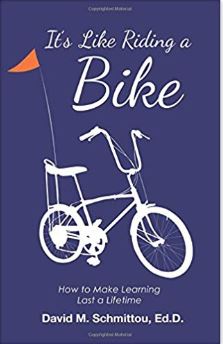
In 2017 my first book on educational methods, titled It’s Like Riding a Bike-How to make learning last a lifetime, was published. With more than 10,000 copies printed, I decided that now is the time to share my thoughts with the world for FREE.
Over ten weeks in the summer/fall of 2023 a chapter of the book will be shared each week via this blog. Feel free to read in any order that works for you. Feel free to bookmark entries to read all at once at a later date. Feel free to share with others. Feel free to disagree with anything you read or to scream your affirmations from the mountain tops. This is for YOU. This is for our kids. This is how we teach so that it lasts a lifetime.
CHAPTER 1
Step 1- Make it safe
When we were kids and were told to go outside and play it wasn’t uncommon for us to grab our bike, flip the kickstand up, and just ride. We knew to be back by the time the streetlights came on, not to ride on the interstate, or to kill ourselves, but that was about the limit of our safe riding guidance. We rode our bikes in the street, hopped curbs onto sidewalks, found ramps to jump, and often had the scars, scabs, and casts to prove our daring. Today, the world is different. As news coverage on concussions and brain injuries becomes more commonplace, as states enact more restrictive safety laws and policies, we are now in a world where buying a stylish, well-fitting helmet takes as much attention as buying the right bicycle. In my own house, I have a daughter with a pink Disney princess helmet, a three-year-old with a helmet displaying a fake mohawk, a blue helmet with baby ducks for my youngest, and a stylish, aerodynamic orange and black helmet for my oldest child. Not only are they going to be safe when they ride, they want to look cool doing it.
Each of my kids is at a different place in their bike riding progression, yet each of them knows that before their butt even hits their seats, their helmets go on their heads. Before attempting to have any fun or learn any new tricks, they must feel and look safe. As you will learn in later chapters, each of my children began the voyage of becoming a bike rider at a different time in their life. It varied based on their physical and mental strength. It varied on their desires and ambitions. But one thing that has not varied, is their need to feel safe and secure before setting out.
In our classrooms, the same responsibility exists. Learning needs to be safe. It needs to exist in a climate free of harm and full of security. We need to metaphorically strap our helmets on and remind our students that they will not be hurt while they are with us. We will set up procedures and processes full of feedback, but free of condemnation. We will avoid sarcasm and put-downs and instead work to boost children up and increase their self-worth. We will plan not only for our academic instruction but will put just as much thought and care into making a safe learning environment as we do to make it rigorous.
We all know that some kids are more prone to injury and insult. There are some kids that will fall down often and need a little more protection. I have one such child. He may need knee pads, elbow pads, and maybe even a Teflon vest to go along with his helmet when on his bike. Not every child needs this much protection, but all will need to at least protect their most vulnerable and essential part, their head. In your classroom, you need to make sure you are also providing the same protection.
We need to be sure kids know they can grow and achieve. We need to make sure they have no fear of failure and falling down. They need to know that although the learning process will be difficult and they will have stumbles, they will not get hurt and will not be harmed. We are there to make sure they are safe. They are protected. They are secure. It is only through security that students are willing to take risks and push boundaries.
So how do you know if your room is safe? Quite simply, are your students willing to take chances? Does every child willingly participate? Do students try new things? Do they come to you for support? Are they willing to put their well-being, their emotional and social well-being as well as their academic well-being, in your hands? If not, what helmets can you build into your room?
During your first two weeks of school do you spend all of your time telling your students what they can and can’t do or do you spend your time trying to establish a relationship, trying to build trust? My kids have all depended on me when learning to ride, in part because I am convenient, but in large part also because they trust that I will do them no harm. They believe that my main priority as their dad is to keep them safe. Yes, I will teach them life lessons. Yes, we will make memories. But more importantly, when they are with me, they feel safe. Is the same true of the students in your class? They may depend on you to teach them the curriculum and to pass out some pretty amazing worksheets, but do they know that you will also give them challenges that are complex and dynamic, but that ultimately you are there to make sure they are safe?
Think about any great relationship you have, whether it is with a lifelong friend, a spouse, or a family member. Your relationship was not built by establishing boundaries from the get-go. It was established by looking for common interests, getting to know each other, sharing hopes and dreams, and establishing connections. If we want our classrooms to be a safe place for risk-taking, we must move beyond simply collecting academic achievement data on our students. We must do more than tell them all the rules and norms of our space. We must form relationships with each and every one of them. It is only from here that we confidently give our students the push they need to begin learning on their own. A thin plastic helmet may make a child feel secure, but the adult running alongside them truly makes them feel safe. Relationships matter, but so also does the environment.
When learning to ride your bike, were you taken to a bumpy gravel road, filled with potholes and debris, or were you guided to a flat parking lot, neighborhood side street, or park? Safety is not just something acquired through a helmet, but also through intentionally thinking through our environment and making it suitable for risk-taking. Riding a bike is a lot safer when we are free of hazards and distractions. If our kids can focus on what is directly in front of them, if they are able to go confidently and smoothly without unnecessary bumps and distortions, the learning process will be more productive.
As a teacher what does your environment look like? Is it set up in such a way that students will be easily derailed? Do you have metaphorical potholes and bumps? At my school, teachers are encouraged to replicate real-world learning environments in their classrooms. When we ask our students to sit in hard student chairs behind heavy desks, to stay quiet, to sit in rows, to stare through ultraviolet lights, we are setting them up for failure. This is not what makes them comfortable. Just like we must adjust the seat height on a bike to make sure it is a nice fit, our students need to be in learning locations that fit them. Classrooms at my school are filled with bean bag chairs, palm trees, beach balls, sandboxes, couches, and recliners. Most kids, when leaving our school, enter a world with soft furniture, gardens, and playgrounds so why not try to replicate that. Kids tend to feel safe and secure at home. If our goal is to help students feel safe at school, why don’t we try to duplicate that environment when they are us? We need to stop trying to convince parents to set up their children’s bedrooms to look like school with a quiet space, desk, and artificial light, and instead try to make our schools look like their homes. Safety and comfort go hand in hand. What can you do right now to help your students feel safe? Just as a word of advice, simply telling your students, “You are safe” won’t really do the trick. It is up to you to create and foster the learning space, to create a climate of trust, and to foster risk-taking if you really want to see learning take root.
To read the introduction, please visit: https://schmittou.net/2023/07/18/its-like-riding-a-bike-the-introduction/
To learn more, visit: https://schmittou.net
 Lasting Learning: Serving leaders, educators, and students.