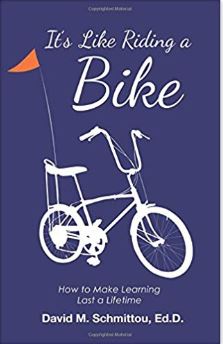
In 2017 my first book on educational methods, titled It’s Like Riding a Bike-How to make learning last a lifetime, was published. With more than 10,000 copies printed, I decided that now is the time to share my thoughts with the world for FREE.
Over ten weeks in the summer/fall of 2023 a chapter of the book will be shared each week via this blog. Feel free to read in any order that works for you. Feel free to bookmark entries to read all at once at a later date. Feel free to share with others. Feel free to disagree with anything you read or to scream your affirmations from the mountain tops. This is for YOU. This is for our kids. This is how we teach so that it lasts a lifetime.
Chapter 2
Step 2-Get to the next driveway, then the end of the block (milestones and goals)
My neighborhood is made up of a series of cul de sacs. I live on a long winding road, laced with speed bumps, that each of the cul de sacs connects to. We tend to get slightly more traffic driving past our home than do some of our neighbors who live on the small dead-end streets, but the speed bumps tend to keep most drivers under control. It is on those small, closed-off, semi-private residential streets that I have taught my children to ride their bikes. Riding on my street, although more convenient, carries with it unnecessary hurdles. There is no reason a beginning bike rider should have to contend with oncoming traffic and speed bumps when a few hundred yards away is a short, straight, flat road seemingly made for them. Although riding in front of my own home is easy for me, what is convenient for me, and my already proficient bike riding skills, is not always what’s best for my beginners.
When my kids are outside riding their bikes, they are told where to go to remain safe. When I am teaching them, I go with them. We walk our bikes to the road we want to ride on. When we arrive, we get set up and look at where we are hoping to go. I remember starting at one end of the street and simply asking my sons and daughter to try and make it to the first driveway. Then we try for the next driveway and eventually work our way all the way to the end of the street. With each success, we would stop and celebrate. I would encourage their progress and we would realign our goals. My kids knew that their ultimate goal was not to learn how to ride a bike down one dead-end road in one neighborhood, but to learn how to ride a bike to explore the world around them with greater ease and clarity. We had to learn and refine our skills in a safe and secure neighborhood, with small measurable goals, but we knew we were doing so to apply them to the greater world.
How does this work in your classroom? Do your students know how everything they are learning will actually make their lives better? Have you set small measurable goals that you can celebrate frequently? It’s not enough to simply tell a student that they need to know a skill so they can pass a test or even so they can feel good about themselves. Learning is about risk-taking. For our students to know that the risks are worth their effort and discomfort, they must feel that they are making progress and that they have your unwavering support.
When you correct an assignment do you mark how many questions a student got wrong, or do you write how many a student got correct? Do you celebrate the students who are being successful in following your routines and procedures or do you focus your energy on those who are struggling? Do you have a way to measure progress every day and every week? Are your kids working towards a goal, a test, or an event way out in the future when all they do is live today or do you have a way to show them that they are getting closer? If we want our kids to succeed, we must be able to show them that success is not a singular event. It is a series of successes built one on top of the other, aiming for a common goal. It is only by celebrating this and scaffolding our goals, just like we do our instruction, that we make progress.
There is a reason my kids all start riding their bikes with training wheels on. I want them to learn the skills of balance and steering, but more importantly, I want them to see the value in riding a bike, to feel the joy of mobility. I want them to think of themselves as bike riders. I want them to feel success. It is ok to put training wheels on your students as well if you have a plan for removing them. Once they come off, do you have a plan for helping them continue to see success and stay upright? The goal is future independence. My guidance and support are the next step, but not the final one. When going out for our first guided lessons on the local dead-end street, my kids each had slightly different approaches. My oldest started with training wheels and then one day just took them off and jumped into independent riding. My daughter required me to run next to her with a beach towel wrapped around her waist to help her balance. My third son needed me to hold onto his seat with one hand and his handlebars with the other. My youngest child hasn’t even begun riding yet and I can’t even begin to imagine what his progression will look like. Ultimately, they will all get to the same “proficient” level although the route to getting there may be a little different for each.
As an adult learner, reading is one of the primary strategies I use to gain new knowledge, but I also know several adults who profess to never read. They gather their knowledge in different ways. Learning can be accomplished through countless strategies, only one of which is reading. Reading is a route to learning, not the way. In our classrooms, our goals must go beyond this. Our goals should not focus on strategies, but on getting students who can analyze, evaluate, and create. This evaluation and analysis of ideas is what students must be able to develop. We should be working to expose our students to a variety of information-sharing formats so that we can work on these high-order skills. We can’t let decoding text be our primary focus anymore. We need our students to be able to collect information and do something with it, no matter where it comes from. My daughter needed me holding a towel around her, my oldest son didn’t. It would be a disservice to her now, as a “proficient” rider to claim that because she acquired her ability differently than others that she is not now successful. In our classrooms we have some children who may learn from reading, some who may learn from watching others, but a whole lot who will only ever learn by doing.
Across America today teachers are being asked to teach and assess their students based upon new standards rooted in high-order thinking. Benjamin Bloom introduced his model of cognitive complexity approximately fifty years ago and schools are just now responding. When I was in elementary school Bloom’s model was more than a decade old. The problem was that the teachers who were teaching me were so focused on replicating their own experiences in school that they were not expected to apply the new theory to learning. Even today, teachers are struggling with incorporating these “new” standards because they were not expected to learn and show evidence of high-order thinking when they were in school. Education is a vicious cycle of repeating the past to try and create new futures. Our schools are filled with teachers who were successful when they were in school. Because they saw success back when they were students, they are doing their best to replicate that experience for our students today. Our former “A” students who were so good at memorizing and recalling information when they were kids are today asking our students to do the same thing and copy an experience instead of creating a new one.
I have had the luxury to work in a half dozen schools as a full-time educator and have visited countless others as a consultant discussing the ideas of high-order thinking, evaluation, and assessment of knowledge. In my travels from school to school I have seen a variety of strategies and a range of successes but have yet to see a system-wide approach of pushing cognitive dissonance, the progressive struggle, or true critical thinking on the part of students. Even those schools that are pushing thinking forward, focusing on Standards Based Learning, the use of formative and summative assessment, etc… are still missing some critical pieces as they continue to put an inordinate emphasis on textual literacy (reading) in their master schedules, their school improvement plans, even in their teacher certification processes.
No Child Left Behind, the federal legislation that tied funding to improvements in reading is one key reason for this. The foundation for this legislation, and all of its related local policies, is that students need to be able to access global information. Students in America need to be prepared for an evolving world, and need to be held to a higher standard than they were. Teachers need to be better trained so that America’s young people will be better prepared to be competitive in a flattening world. This singular focus, however, may have led to some unintended consequences.
In every state in America now, schools are becoming more transparent as they are asked to publicly advertise their success on standardized tests that presume to measure student preparedness for success at the next level. Students from 3rd-12th grade are assessed every year on their ability to read and it is the results of these assessments that serve as the key determinant in whether or not a school is designated as high performing or struggling, whether it receives sanctions or praise, funding or closure. It makes sense that schools, and the staff that make up the schools, would put such an emphasis on this singular discipline or skill set. We have lost sight of creating well rounded future adults, individuals who are able
We are often told that for students to learn about the world around them, they need to read more and that reading equates to more well-rounded learners. If we would just get our kids to pick up books and read, they would be so much better informed. The fact is, however, that, as schools have put such a large emphasis on reading, our science and social studies scores on all standardized measures have continued to fall. As our teachers put more of a focus on reading our kids are seemingly becoming less informed about the world around them. This is true across the country. It doesn’t make sense according to the logic provided by so many in the educational establishment and here is why.
If you are at home in your office or in your den where you can see your bookshelf, take a look at the books that are on the shelf. Do you have any books about nuclear physics? How about the breeding habits of termites? Do you have any books about the moons of Jupiter? I doubt it. I know I don’t. What do you have books about? My guess is that you have books about things that you are already interested in and already have a basic understanding of. In my home office, I have approximately 1000 books sitting on my shelves covering topics ranging from the history of America to the future of society. I do not have any books about fifth-century China or how to crochet. I don’t have any books about how to be a competitive cheerleader or how to distinguish a moth from a butterfly even though I am sure such books exist somewhere. Why? Because my interest in those subjects has not been sparked yet. We pick up books to enhance our knowledge. Very rarely do we read to create new knowledge. The more science and social studies we know, the better readers we will become. It is not the other way around. To create better readers, we need to make contextual associations. What we will read will be relevant to us if we have a context already established about what we are reading, and we can then begin to analyze and make inferences.
Have you ever tried to read a Dr. Seuss book to a child without showing him the pictures? Often the nonsense words in those books make no sense unless a child is able to see a picture to provide a point of reference. The same is true for a child picking up so many of our textbooks in school. To many, the words on the page are simply nonsense because they have no context in which to make a reference. As a child, I picked up books about the world wars and baseball because I already had some knowledge and interest in those subjects. I was playing baseball and hearing stories about the wars. If we want better readers, we need to put less emphasis on reading and more emphasis on learning. In colleges of teacher education, we need future educators to learn how to facilitate learning, to learn how to challenge students and engage them in high-order thinking. We do not need teachers with a singular content focus. We need to move away from certifying teachers because they know one subject area well enough to pass a certification test. We need teachers who are learning experts. We need teachers who are able to get kids excited about learning. If we want our children to want to pick up books, we need to give them some passion. We need to make learning fun, engaging, and real.
It seems that in America today there are a lot of people who have bought into the idea of reading being an end goal instead of a route to learning. In 2014 there were more than 300,000 books published in the United States. That’s almost 100 books per day. Why is it that so many people are choosing to write and publish texts? Hey, I’m even guilty of this. Is it really because there is that much new knowledge in the world to be shared and so many people willing to write about it, or is it is that there is a feeling that being published equates to some sort of status or accomplishment? Regardless of the motivations, knowing that so many people, from so many different experiences and knowledge bases are getting books published gives me pause, because surely not all books are created equal. Surely not all are rooted in fact and accuracy. Surely reading some of these new titles may lead me astray. Before I pick up anything to read, whether it’s the Sunday newspaper or a popular new novel, I need to be sure I am prepared to analyze the words on the page so that I can make informed inferences and not just take the written word at face value. Too many people in this world have been led astray by doing just that. It’s not always as notorious as a Facebook creeper or a malicious help-wanted ad, but the approach is the same. If you are not able to distinguish between fact and fiction, if you are not able to determine intent and motive, if you are not able to effectively analyze and evaluate what you are reading, your life can change in an instant. The good news is that reading is not the only strategy for learning. Our kids today know this. It’s about time we educators figure this out as well.
Here is a small challenge to help confirm this point. After all, I don’t want you to just accept these written words as true simply because you are reading them. That would go against everything I am trying to explain. Here’s what I want you to do. When you complete reading this chapter, (don’t do it now, you need to gain a little more background first) try this and see what you discover. Go turn on your TV. That’s right. Set this book down, walk over, and turn on your TV. Go to your channel guide and start sorting through your various channels and see what is being broadcast right now. It really doesn’t matter if you are reading this as a part of your morning routine at 6:00am or before going to bed at 10:00pm. The time of day doesn’t matter. Once you turn on the TV and switch to the TV Guide decide, of all the options available to you, how many shows would you be willing to sit down and watch? What shows really capture your interest? Be mindful of the fact that for some reason you have already decided to forego TV watching right now to read but assume that you actually wanted to just watch TV. Would you want to watch every show that is on or would you be selective based on your tastes and interests? Would you watch a sporting event or a cooking show? Would you choose a cable news program or a sitcom? How would you decide how to spend your time?
When it comes to our own TV viewing, we have selection criteria based off of what intrigues and excites us. Why do we expect it to be any different from our reading habits? In my own home, with my own kids, I know I have messed up on this. I have made the statement that they need to turn off the TV and go pick up a book. “What book?”, they ask, and I respond with, “I don’t care, just go read.” They may have been watching something that collectively got them to interact and laugh together. It may have been a Disney Channel show that got them all in the room together learning the art of sharing a couch. They probably practiced advanced negotiations to even settle for the show they were watching. They may have been learning much-needed social skills that I dismissed by sending them to their rooms to pick up a book that they will read by themselves perhaps making no lasting connections and acquiring no real new learning. Not all TV is bad. Bad TV is bad. Likewise, not all reading is good. Good reading is good.
Of the 300,000 books published this year, odds are that very few will ever be seen by future generations as classic texts. Very few will make their authors any money or give them a platform for educating and informing others. Just like in Hollywood, not every movie will be seen as a Blockbuster earning the directors and actors millions of dollars, the same is true for authors. Our goal must go beyond textual fluency and comprehension. We must strive for literacy: information literacy, media literacy, textual literacy, etc… We need to help our students learn how to learn and we need to be willing to embrace that learning happens in a variety of ways, so although I think reading is a helpful tool for me, I don’t care if my kids choose to read. I want my kids to learn.
*********************************************
Last week I was scrolling through my Twitter feed and saw an insightful phrase. The author wrote “Bloom’s taxonomy- the most often quoted research in education that nobody has actually read.” We live in an age where platitudes and generalities rule. We hear a sweeping declaration and assume it must be true. We can look at Facebook any night of the week and read about the latest teacher who is destroying math as we know it by embracing “Common Core Math” and teaching students why numbers make sense and not just teaching students to memorize formulas. We turn on the TV at night and realize that most young adults are getting their news from Comedy Central and not from any of the major networks. We watch election campaigns where candidates speak with passion and anger and rarely voice an agenda or innovation.
The inability to determine fact from fiction or opinion from information is not just an issue for our kids. As adults, we are not immune. We get sucked into the same trap as the kids we are trying to teach. We argue that we want our students to make informed decisions based on logic and reasoning, yet we get fooled by following mass media and popular, often unfounded, opinions. Then we go into our classrooms and teach our students to do the exact same thing. We put students in our classrooms and scold them when they copy off of their peers but celebrate when they copy off of us. We ask students to learn the skills of collaboration, but then ask them to simply do what we do and believe what we say. As adults, we thrive on convenience and ease. We live busy lives and want our pizza delivered, our groceries bagged, our money direct deposited, our retirement accounts managed, our cable, internet, and phone bundled, and our lives to be directed by others; although we would never say that out loud because after all, we are a nation of independent thinkers and innovators. We are educators of the next generation of inventors and engineers, and if our students would just do what we said, how we said it, they would learn to think for themselves. For those of you who may still be taking this text at face value, that was sarcasm.
As I am writing this, I am currently in my seventeenth year as a public school educator. I have been a middle school teacher, a director of gifted programming, a coach, a dean, an assistant principal, and a principal. I have worked in four districts and two states. I have had the opportunity to travel to almost every state in America presenting and collaborating and have met some amazing people. I have been blessed by my opportunities, yet I still have a drive for more, a drive that sometimes makes me do some stupid things. In 2003 I made some costly mistakes.
That year I graduated with a master’s degree in educational leadership. This was only three years after starting my career as a teacher and I was already a certified “leader” in education. After three years I knew I had all the answers and I was ready to be the next great leader in the world of public education. I was ready to jump in and get a title as an administrator and start guiding my teachers to change everything they were doing and start copying my way of teaching so that they would all see great success. After all, we all know leadership is just a title, and once you get the title people immediately respect you and want to do everything you say. During the calendar year of 2003, I went on fourteen job interviews seeking either an assistant principalship or a school principal position knowing full well that somebody would hire a young administrator who obviously knew it all. After visiting fourteen different schools and meeting with fourteen different committees I was granted a total of ZERO job offers. Zero!! I was the next best thing to happen to schools. I knew it, after all, I was a successful student in school. I had worked as a teacher for three whole years, basically copying all of the techniques of the best teachers I had when I was a kid, and my kids were all getting great grades assigned by me. For the buildings and districts, I was interviewing in not to recognize how amazing I was, was a complete injustice, a disservice to the students they were paid to educate, or so I thought. I was a man who was used to standing in front of 150 kids every day all of whom expected me to have the answer to everything. I was paid to have the most knowledge in the room. I was definitely smarter than all of the twelve-year-olds I had assigned to me. I proved it every day by shutting down all their “disrespect” for questioning my sound logic and for debating my reasoning. These twelve-year-olds had no right to question my authority and my intelligence by asking for clarity or seeking new ways of answering old problems. I was a master teacher, and I had no room for pre-teens to question why the world worked as it did. They needed to simply listen to what I was telling them and they would know all they needed to know.
In the fall of 2003, after facing a summer of rejections, I decided to prove to everyone just how smart I was. With so many doors to school administration being slammed shut in front of me, I decided to try my hand at law school and really put my intelligence to the test and on display. After all, everyone knows doctors and lawyers are the smartest people around, and I was so much more than “just a teacher” so why not join the ranks of the elites.
The fall of 2003 was one of the most humbling seasons of my life. Law school was like no school I had ever been in before. Law school required me to think and answer questions that had no answers. My professors spent very little time giving me statistics and data, but instead spent the bulk of their time asking me questions. I now know this is known as the Socratic Method of teaching, named after the ancient Greek philosopher, but then I simply thought of it as torture. I was so good at playing school, yet this was such a struggle. I had passed my GRE and LSAT exams with such ease, yet I was having difficulty being placed in an environment where I was being asked to think for myself. I was expected to read cases, read legislation, read interpretations, and then evaluate texts and ideas through my own lens looking for errors, omissions, lapses in judgment, or causes for celebration. My professors were not doing school as I had always experienced it and always proven myself successful. They were doing all they could to question my thinking and challenge me to reflect and develop a sense of analysis and evaluation that I had never experienced. Looking back on it now, I am thankful that I was not given a leadership position prior to that experience as I probably would have worked tirelessly to simply create schools that were similar to the ones I had always been a part of, schools that work well for kids that know how to play school, schools that are good at creating future teachers, but struggle to live up to their mission of creating lifelong learners.
Thirteen years later, I now see the proverbial light. A light that is not a focused laser, but a dispersion of colors. In all that I do professionally, my goal is to help educators question what they do and why they are doing it. The goal is not to judge and condemn but to help us all focus on our intentionality. So, let me ask you, in your classroom, in your school, are you working to create thinkers, or are you working to create students who can repeat every word you say and every text you ask them to read? Are you trying to help create kids who can describe the way the world was or kids who can help create the world to be? In a world where more than 300,000 full-print books are published every year, we need to work to create a population that does not just thrive on the knowledge available in texts today. We cannot just have our students pick up books, sit in our classrooms listening to us, and expect them to know all they need to know to be successful in the world they will inherit. We need to teach our students how to learn, in a variety of ways, in a variety of contexts, for a variety of reasons. We need to teach our students how to process information from social media, from their peers, from politicians, from digital media, as well as from print media. We need to teach our students how to go beyond recalling, remembering, and understanding information to get them to a point where they are analyzing, evaluating, and creating information. In order for us to do that with our students, we as adults must first learn how to do this ourselves. We need to be able to guide the process, to model it, or at least enable it. So how do we do it?
Visit https://schmittou.net to read earlier chapters.
 Lasting Learning: Serving leaders, educators, and students.