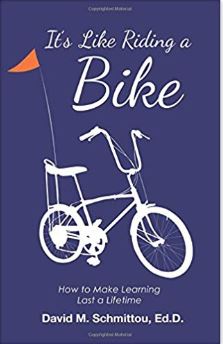
In 2017 my first book on educational methods, titled It’s Like Riding a Bike-How to make learning last a lifetime, was published. With more than 10,000 copies printed, I decided that now is the time to share my thoughts with the world for FREE.
Over ten weeks in the summer/fall of 2023 a chapter of the book will be shared each week via this blog. Feel free to read in any order that works for you. Feel free to bookmark entries to read all at once at a later date. Feel free to share with others. Feel free to disagree with anything you read or to scream your affirmations from the mountain tops. This is for YOU. This is for our kids. This is how we teach so that it lasts a lifetime.
Chapter 5
Step 5-Cheer them on
When I was a student teaching in the suburbs of Detroit, I endured some minor hazing. I was asked to be a part of every committee, coach every sport, and one Friday afternoon, was told to dress up in a skirt and wig to play the part of a passionate cheerleader rooting kids on to success during a Homecoming pep rally. As a 22-year-old male, fresh out of college, I really had no problem with being a little crazy, but little did I know that wearing that outfit and playing that part would be a metaphor for my teaching throughout my career.
I absolutely love teaching. It is my calling, my passion, and my mission. Not because I love everything I teach, but because I love everyone I teach. Teaching is hard work. The planning, the grading, the reflecting, the meeting, the collaborating, never seems to end, and I LOVE IT. Parenting is the same way. Whenever I tell people I have four kids I always hear back, “Wow, you must be busy.” The truth is, I was busy when I had one kid. I would be busy if I had ten kids. Being a parent does mean you are busy, but I wouldn’t trade it for the world.
As a parent, I do all I can to carve out individual time for each of my kids to spend with me. I want them to know that I value them, and they are important to me. I want to be at their soccer games, their baseball tournaments, their dance recitals. I want to be able to support them through everything. I want them to know I will be their guide, their support, and their life-long teacher. I want to be the one to teach them how to tie their shoes, to brush their teeth, and to ride their bikes. Every child needs a cheerleader who pushes them beyond what they can do to accomplish something new.
There is a reason universities and high schools across the country invest money and time into having cheerleading programs. Cheerleaders, beyond building their own individual skills and team mindsets, help develop an overall culture of optimism and hope. The job of a cheerleader is to instill hope about what is possible. When a cheerleader is asked to perform at a football game in which her team is losing, they don’t lead the crowd in a cheer of defeat and despair. Instead, they try to offer encouragement and hope. Their job is to rally the troops and get them back up. As a dad, when my children are learning anything new, that is my responsibility as well. When they are wobbling on their bike, when they fall down, when they think it is too hard, my job is not to sit them down and tell them that maybe bike riding just isn’t for them. I would never say to my kids, “You know some people are just walkers and others are bike riders. Maybe you are just a walker.” I would instead inspire them and motivate them to understand that with persistence and practice, they can overcome their current ability to do more.
How many times have you heard classroom teachers tell their students, “You know math isn’t for everyone” or “Some people are just creative” or some other excuse to inspire a child to give up? Our job as teachers is to remind our students that learning is hard. It is a struggle if done right. It will cause some bruises, some humility, and some frustration, but it can be done. Our job is to reach out our hand and pick each child up and show them their potential, to keep their eyes on the ultimate goal and not the struggle they are currently enduring. Our job is to use current circumstances to game plan for future success.
You can read countless studies on the dangers that exist when we begin to label kids. As a teacher who spent several years teaching children identified as “At-risk” as well as children labeled as “Gifted”, I know children will embrace whatever labels are placed upon them. I have had struggling students state that they “can’t do…” simply because in the past an adult told them that they can’t. Likewise, I have had “gifted” students say they are not supposed to ever struggle, again because of what they have been told to believe about themselves. The truth is kids will always live up to our expectations when they know what they are. If your children are not persisting and finding success however you describe it, odds are the fault is not with the child. Either you have not made your expectations known or you have and your expectations are that they won’t be able to succeed.
Get in the habit of cheering your children on. Success breeds success. It is the most contagious virus available in your school. Find something small and cheer it. You will be surprised how that one victory leads to the accomplishment of so much more.
Using a rubric of learning is a step in the right direction. Rubrics have been around for decades in education. Many times, teachers hear the word rubric and synonymously think, grade requirements. They create a checklist of tasks or directions and give students points based on their ability to jump through hoops and create a project that meets their specifications. Maybe a child will earn 10 points for having a picture on their poster board. Perhaps spelling and grammar are worth another 10 points on the assignment and having relevant information in a poster presentation is worth 30 points. A child completes their project, and presents information to the class while the teacher holds onto a rubric in the back of the room and assigns a grade of 35/50 because although the student demonstrated a thorough understanding of the content, she may not have had a colorful picture and may have misspelled a few words. The student gets their rubric back and sees a score of 70%, C-, written at the top. According to my already described rule of 80, this child, who demonstrated understanding of the content, is not considered proficient (reaching 80%) because she did not color in a picture and misspelled a word or two. Something about that does not seem right.
I know, we must get kids used to paying attention to the details, used to following directions and following rules. I have no problem with holding kids accountable for almost anything you as the teacher feels is important, however, each night, you as the teacher must go home and make a series of decisions. You must decide: did the kids understand the content I presented, do I need to reteach, what do I need to re-teach, and who is ready for something new. A teacher can try to rely on her memory of all her 120 students and every interaction she had with each one, but inevitably somebody or some encounter will be forgotten. Instead, to try and make informed decisions she decides to take a quick look at her grades.
Looking at her gradebook she sees a series of numbers from 0-50 scattered throughout. These numbers do absolutely nothing to guide her forward. She has no clue if today was a good day or a bad day. Even that score of 35/50 doesn’t do much. Did the child have a great colorful picture and a perfect presentation in terms of syntax but miss the content or did they show that they mastered the content but made some missteps with their presentation? Perhaps the subject matter being discussed in class contained several smaller essential concepts that required varying degrees of understanding. Do I, as the teacher, know what each child knows and doesn’t and to what depth? Do my grades help me make informed decisions about what I need to do to help each child progress tomorrow? If not, my ability to make student-centered instructional decisions is limited and I will find myself making decisions out of convenience just doing what I think is best based on my gut instincts, which is exactly what I have been doing for years anyway. Somehow teachers must find a new way. Lucky for you there is a new way, based on the same rubric system many of you are already familiar with.
Unlike the rubrics that most teachers are accustomed to that are focused on evaluating a task, these rubrics assess learning, not compliance. A rubric of learning is not task specific. A rubric of learning, if developed correctly, can be used on an infinite number of tasks and has a simple purpose, to determine student understanding. They are not created to judge and assign a grade, but to diagnose and provide prescriptive information. Rubrics of learning serve as a tool to the practitioner and feedback to the learner.
Below is a template for what one of these rubrics might look like. Begin by looking at it. If it makes perfect sense to you, feel free to stop reading here and get into your classroom and start implementing it. For the rest of us, a little explanation may be needed. After all, if you could make sense of it all by just seeing this one graphic, I could have just saved you a few hundred pages of reading. Sometimes an explanation helps.

These rubrics come into play once you as the teacher have selected your ten to fifteen Power Standards for the year. You know that different kids learn in different ways, at different times, and with different styles. You know that each standard you have is complex and sometimes difficult to understand. You know that great teachers can take complex concepts and simplify them by breaking them down. You know your job is to take every child where they are and move them to a point of greater understanding. You also know that somehow you must be able to document where your kids are at all times so that you can make informed, student-centric decisions. You know that because kids learn in different ways, there is also the reality that they can display their understanding of content in different ways. The rubric of learning is a great starting point.
In this template, I use a 4-point scale. A four-point scale is helpful for a lot of reasons but is not essential. You can deviate from this and use three points, five points, or any total that is consistently applied to every standard. If a teacher decided to use the four-point rubric as their means of assigning grades, she could do so pretty easily as so many schools already do a variation of this by taking their existing report card letter grades and converting them to a grade point average (g.p.a) on a 4-point scale. Using a four-point rubric helps eliminate the need for a cumbersome letter grade translation that is interpreted in different ways by so many different people and allows the learner and the teacher to see a simple quantifiable assessment of understanding.
The primary purpose of using a four-point rubric is NOT about assigning a grade, however. It is not about labeling success and failure. It is about assessing a current understanding and diagnosing prescriptive instruction. It allows us to inspire future success rooted in current reality. It allows us to play cheerleader, to look at a scoreboard, and remind a student that the game is not done yet.
The last time you took your car to a mechanic you experienced something similar. Twenty years ago when your car had to go to the shop you wheeled your car into the garage and let a mechanic bang around under the hood until he was able to create an invoice of a dozen emergencies that had to be addressed for a few hundred dollars. Not being an expert in automobile mechanics you were forced to take his word for it and write the check. Now, cars are equipped with diagnostic computers. A trip to a mechanic now involves your car getting hooked up to a computer that within a few minutes can pinpoint mechanical issues so that only the specific problem gets addressed and you no longer have to spend your time and money waiting for an expert to adjust everything under the hood to eventually stumble upon a solution. As a teacher, using a rubric of learning allows you to pinpoint what needs to be addressed and what is already working saving you valuable time and resources.
Let’s walk through a fictitious example. Let’s assume you have a standard that reads, “Students will be able to apply the principles of balance, coordination, gross motor skills, and dexterity to successfully ride a bike.” I am using a fictitious example because I know how critical it is for you to be able to work through the real standards on your own and with your peers. That struggle and conversation you will have is a part of the process of learning the standards. In our example, with a 4-point scale, the teacher (you) would look at the standard and identify the verb, in this case, APPLY. It is assumed that this step was already completed during the decision-making process of selecting this standard as one of our Power Standards. We know that by looking at that one verb, our students are all going to be asked to produce evidence that shows they can apply some new knowledge. In a four-point rubric, we use our Level 3 column to detail that standard performance expectation so the word APPLY is filled in throughout.
| 1 (Not Quite) | 2 (Almost) | 3 (Got it) | 4 (Advanced) | |
| APPLY … | ||||
| APPLY … | ||||
| APPLY…. | ||||
| APPLY…. |
Application is our standard goal for all kids for this standard, but we understand that not all students will be at this required depth at the same time. It is not adjusted because a student may have a label. The label may help us select our instructional approach, but remember a standard is only standard if it is standard. Different kids will begin with different levels of understanding. Using Blooms Taxonomy as a guide (you may also choose to use Webb’s Depth of Knowledge if you are more comfortable with it), a level 2 would contain a verb with a lower level of complexity, and a level 1 would be even more simplistic. In this example Level 2 may involve showing an understanding of the essential concept and level 1 may be as low level as recall. The rubric allows the teacher to identify what depth of understanding a student is able to demonstrate evidence of and then allows the teacher to pinpoint future instruction.
| 1 (Not Quite) | 2 (Almost) | 3 (Got it) | 4 (Advanced) | |
| RECALL… | UNDERSTAND… | APPLY … | ||
| RECALL… | UNDERSTAND… | APPLY … | ||
| RECALL… | UNDERSTAND… | APPLY… | ||
| RECALL… | UNDERSTAND… | APPLY… |
Detailing the verbs (the student expectation) for the first three levels on the rubric is always the first thing to do on a rubric. Looking back at Chapter 2 of this book you have a quick cheat sheet. If you can identify the verb from the standard, you simply move backward down Bloom’s Taxonomy to represent lower levels of understanding.
The next step is to try and articulate the WHAT of the standard. Each standard describes an action and the content that students will have to create evidence for. In our example, there are four explicitly stated subjects: Balance, Coordination, Gross Motor Skills, and Dexterity. As a teacher, you may choose to break these concepts down even further to gather greater prescriptive information, but for our purposes, we will just use those four. These four subjects become the first column on our rubric. They are what we will be measuring as we assess student understanding.
| 1 (Not Quite) | 2 (Almost) | 3 (Got it) | 4 (Advanced) | |
| Balance | RECALL… | UNDERSTAND… | APPLY … | |
| Coordination | RECALL… | UNDERSTAND… | APPLY … | |
| Gross motor skills | RECALL… | UNDERSTAND… | APPLY…. | |
| Dexterity | RECALL… | UNDERSTAND… | APPLY…. |
In the above example, I have not provided great amounts of detail within each cell. For example, in the “1” Column we only see Recall…. Balance. As the teacher you may decide that the student needs to be able to recite from memory the definition of balance, simply match the proper definition of balance from a list of options, or do other basic recall functions. How you as the teacher, or how as the student, this is elected to be demonstrated is not of the utmost importance. This column, on this rubric, concerns itself with a student’s ability to remember basic information. The format of the assessment is not critical. Remember I am not going to offer a magic pill. What matters is your ability to measure student learning and its depth. As a matter of fact, I would argue, the formatting of the assessment at levels 1 and 2 is almost inconsequential. It isn’t our goal to get a child to be successful at a level 1 level. Our goal is to get them to at least a level 3.
Let me add one more caveat while we are at this juncture. Moving to a greater depth of understanding is not the same as working towards harder work. These rubrics do not move a child from easy to hard. They measure depth. As a former social studies and language arts teacher I will be the first to admit that I am horrible at memorizing dates or spelling words correctly. These skills involve low-level recall but are very difficult for me. If I am given dates or words on a page and asked to draw comparisons, analyze, or apply information at a greater depth, I can do so a lot easier on most topics than if I am asked to memorize information I may see as trivial. What I can do is not necessarily harder work, but indicates a deeper understanding.
When a teacher is assessing a student’s knowledge with one of these rubrics it is not essential to first evaluate whether or not a student can perform a level 1 skill before evaluating their ability to demonstrate levels 2 and 3. In fact, I would argue it should be done in reverse. Because these rubrics are to be used as diagnostic tools a teacher should begin by measuring if a student is proficient at the standard level (Level 3). If so, then there is no need to measure the levels below. It is only if a student is not able to perform at a level consistent with the standard that a teacher should begin to assess what a child can do, and what they are able to understand, as that will provide the foundation for future instruction and allow the teacher to know where to begin tomorrow.
But what about the student who can show proficiency earlier than his peers? In the past teachers would use this student to help teach others, arguing that would help them really understand the material better. Although this may be true, most teachers really had no way to prove it, nor was it always fair for students. Just because a child may have a better grasp of a concept should not mean they are given more work and the responsibility to bring up others who may be struggling. As teachers, it is our responsibility to help every child grow, including those who may be moving quicker than others. With a 4-point rubric, we are given some guidance on how to do this.
Once a child has demonstrated that they have a grasp of the minimum standard by achieving a level 3, you as the teacher must decide what’s next. Although the best teachers are those who possess Bold Humility, it is an arrogant teacher who believes the only thing kids need is the teacher to learn everything. It is possible that some kids have already learned a few things before coming to you. Using Blooms Taxonomy as our guide again, we have some options. We should simply look at our list of verbs and identify a skill that shows greater depth than the proficient level. Let’s look at our example again. In our sample rubric, students had to apply their knowledge of four concepts. To show their ability to apply their skills we might ask them to ride their bike and measure their ability to demonstrate the four measurable objectives of balance, coordination, gross motor skills, and dexterity. In most classes, you will have some students who can do this skill and some who cannot when we decide to assess it. In the past, most of us would probably look at a kid who could ride his bike proficiently and either ask him to teach other kids how to ride or we would tell the student to begin working on a new standard. Again, there is nothing wrong with that, but it is not necessarily helping that child grow.
What if we took the verb ANALYZE ( a skill higher on the Bloom’s Taxonomy pyramid) and asked our students to compare two different bike designs and distinguish between their form and function? What if we had them EVALUATE professional BMX riders and determine who has a more advanced skill set? What if we had them CREATE and DESIGN a new form of transportation that requires all four components of bike riding but in unique ways? Can you see how this helps encourage our kids to become innovators and creators? Can you imagine the energy in your classroom as students work tirelessly to demonstrate they are proficient in a standard so they can then begin to create and design? Who knew assessment could be such a motivating force for kids?
In schools across the country, teachers are taking this new approach to assessment and using it to challenge the instruction they are able to provide students. What I have seen evolve is truly amazing. I have seen teachers turn a basic four-point rubric and create a more complex eight-point rubric using each of Bloom’s levels plus a level for reflection. These teachers work with teachers at other grade levels and create a master rubric for their entire department. For example, in a middle school, a 6th-grade teacher may be responsible for the first four columns and be asked to get students at least to level 3 of application. The seventh-grade teacher is then able to make their starting point the level 3 because she knows at least 80% of her students are beginning there and she moves to columns 3, 4, 5, and 6 trying to get 80% of her students to synthesis before an 8th-grade teacher jumps in and moves to the last four columns on their master rubric.
This level of complexity and coordination is taking this understanding to a remarkable level. I have seen some schools use these rubrics in every classroom and move away from grading any individual assignments. In a gradebook teachers begin assigning scores of 1-4 on each individual learning objective. Some schools hold onto letter grades to supposedly ease the transition for parents and create a new grading scale that takes scores of 1-4 and converts them to the appropriate A-F letter grade. Ultimately how these rubrics are translated into student labels is not important. What really matters is how teachers can use this information to enhance the learning experience they can give to students. These rubrics can be used to assess students using an unlimited number of tasks because it’s not the task that is important. We are not trying to determine a student’s level of compliance in completing work. We are trying to determine what a child knows so that we can give them more knowledge.
If you begin creating your rubrics and you have a singular project or activity in mind, stop right there. If this is done correctly, a singular rubric can be used by all teachers responsible for the same standard, regardless of the projects, tasks, or pedagogical style used. If teachers are willing to talk and debate openly about what evidence is satisfactory to demonstrate understanding, there are no limits.
At the end of a school year, a teacher may end up with 10-15 rubrics, one for each standard. These are used to assess all students all year long. As a teacher, you are susceptible to bias and misinterpretations from time to time. Although you are the most important tool available to students, it is important to check for validity. When state assessment scores become public your scores should be showing student growth consistent with what you saw in your classroom. Your students are showing a mastery of standards that should translate into the ability to show understanding in a variety of formats, even a standardized test (I have seen evidence of this in every district and school that has adopted this method). The following year teachers at the next grade level should see evidence that your students have retained the knowledge you promised would have endurance. If not, as a teacher with bold HUMILITY, you must be willing to reflect on what you have created. Do you need to realign the order in which you are teaching specific standards to better match up with other subjects or classes? Maybe you need to reevaluate the standards that you found as the most powerful. As a teacher, your power needs to be harnessed and evaluated often just as the learning of your students is assessed.
As the months and years begin to pass, your expertise in the use of rubrics will evolve and grow as well, showing a greater understanding. Perhaps you started off with ten distinct rubrics measuring ten unique Power Standards and now have one large master rubric with fifty embedded skills. Maybe now you are cutting and pasting skills across standards to have units of study that allow you to assess skills from several standards all in one unit. Perhaps you are embracing the work of Rick Womeli and allowing students multiple redos and retries to demonstrate proficiency and not just relying on one attempt? Maybe you are throwing caution to the wind and embracing the work of Dave Burgess and teaching like a pirate to get your students excited about learning content that you know to be essential to their development.
Using a rubric of learning derived from a Power Standard does not just help with Standards Based Grading, it allows a practitioner of knowledge, a scientist, or a teacher to become an artist. It allows a teacher to look at a canvas and evolve it to grow based off if its specific needs and abilities. It turns assessment into a diagnostic instrument, not a label-making machine.
Learning comes in so many forms and fashions. Reading helps many people grow, but it is not for everyone. A paper-pencil test helps us label achievement but does little to help us shape our instruction. As a teacher, it is my mission to help kids learn. It is my job to do whatever is necessary to take every child where they are and move them beyond to a new level of competence and understanding. My job is to change destinies. My job is to create students who may not be perfect today but will be successful tomorrow. My job is to capture a child’s curiosity, fan its flames, and use it to my advantage. I will do all of this by teaching to the test, every test, the tests of life. I will use every resource available, no matter what it is, because ultimately, I don’t care if my kids can read. I just want them to learn. I want to be bold enough to stand up for what is best for my kids and humble enough to realize that my way is not the only way.
Read earlier chapters at https://schmittou.net
 Lasting Learning: Serving leaders, educators, and students.