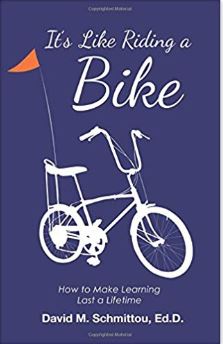
In 2017 my first book on educational methods, titled It’s Like Riding a Bike-How to make learning last a lifetime, was published. With more than 10,000 copies printed, I decided that now is the time to share my thoughts with the world for FREE.
Over ten weeks in the summer/fall of 2023 a chapter of the book will be shared each week via this blog. Feel free to read in any order that works for you. Feel free to bookmark entries to read all at once at a later date. Feel free to share with others. Feel free to disagree with anything you read or to scream your affirmations from the mountain tops. This is for YOU. This is for our kids. This is how we teach so that it lasts a lifetime.
Chapter 6
Step 6-Make practice fun
Once a child has figured out the techniques of becoming a bike rider they will want to go outside and ride constantly. Most kids will not immediately ask if they can start riding their bikes to specific destinations and using their new skills for utility. Instead, they will want to go outside and just have fun. They may simply ride up and down the block. They may just want to go for family rides or cruises with their friends. One thing they will never ask to do is to sit down and complete a worksheet to prove they can ride a bike. They will never ask if they can ride independently for twenty minutes to build stamina or ride twenty laps to increase endurance. They want to just go and have fun and make their new skill a part of who they are by playing and finding their own ways to incorporate it into their day-to-day. Practice should be fun if we want it to be sustained. It should be child-driven, should be encouraged, and should be encouraged to happen often. Most importantly in all of this though is that it should lead to continued growth.
As a former middle school social studies teacher, I had a rule for my students. On Mondays, I would introduce the topic of what we would be learning for the week ahead. If I could not clearly articulate how that learning would help them in life, students had the right to veto my ideas. This was a great challenge for me as a teacher to examine the relevance of all that I did. Where I fell short, however, was this exact concept I am writing about now. I would often spend hours planning for my powerfully engaging lesson that would wow the kids and hook them in during my 50-minute period. Then, once kids left my room, everything was stopped. I did not provide any opportunities for continued, relevant practice. Sure, I would send kids home with some homework to do (a practice I am now actually opposed to) but often what I sent them home with was far less engaging than what I had them do with me. My own arrogance often got in the way. I would think that the real learning could only happen while a child was with me, but, most learning actually happens during the reflections after any given experience.
As an adult learner, I often have a difficult time falling asleep at night because of all that is in my head from the day before. My children are notorious for calling me back into their rooms after I have tucked them in because they are thinking about something that occurred previously and they are now making some connection. When my kids first began riding bikes they learned the basics from me, but their ability to skid to a stop, jump curbs, and really become masters of the skill often happened when I was nowhere around. It happened because they wanted to go practice and play. They wanted to get better. That rarely happened in my classroom, and I know it was my fault. Just like my kids would have lost a passion for riding if I gave them a checklist of tasks to complete during scripted riding practice time, my students often lost interest at home because what was engaging in class was turned into a task at home. Students spent 50 minutes learning from me and instead of fanning those flames when sending them off, I often smothered the flames by making them jump through worthless hoops. Practice must be fun. Make it collaborative with friends. Make it driven by student choice. Make it whatever the kids want as long as they are trying something new with the foundational skills you helped them acquire.
Some of my best friends are literacy experts. They spend their days working with children from 5-15 years old trying to teach them the skills needed to read. They believe in what they are doing and are very good at it. The students they work with are typically identified through a variety of assessments as being in need of special interventions and are then given the opportunity to receive additional support as a result of test scores that show they are lagging behind their peers. Classroom teachers across America are asked to give these assessments with increasing frequency with the goal being to identify those struggling with basic literacy so that they can receive the support needed to catch up to their peers. This type of work is extremely valuable, and it is needed. My issue is not with those giving children the skills to read, it is simply with the system’s seemingly singular emphasis on this lone skill.
As a father of four children, I spend approximately two hours every night reading to my kids. Each child gets his/her alone time with me before bed where we get to say our prayers and read a few books together. This is my favorite time of each day. It is an opportunity for me to sit down one on one with each child, captivate their imagination, and teach them something they may not have had the chance to learn on their own. My three youngest children (a baby, a three-year-old, and a five-year-old at the time of this writing) love picture books. Dr. Seuss, H. A. Rey, and William Steig are staples, with their stories of mischief and make-believe. My kids love to look at the colorful illustrations as I read aloud the nonsensical stories and smile while interpreting the text.
My now ten-year-old enjoys a good story at night as well. He and I, however, do not share picture books anymore. Now it is more Magic Tree House, I Survived, or a good James Patterson. My son will tuck himself into bed, close his eyes, and just listen as I spin the tale described for me on the written page. Often, he will fall asleep before I finish reading more than a few pages, probably drifting into a dream about whatever plot was being described.
So how can a man who gets to experience such a time as this every night, a time of uninterrupted solitude with just his children and a good book claim to believe that reading is overrated? Well, I don’t. I love to read. I love sharing these moments with them and reading to them. When I am reading to them, I am basically playing the role of a storyteller. They oftentimes have their eyes closed, making mental images without looking at a single written word. They find themselves lost in the stories, listening to my words, but are not tasked with the responsibility of decoding written text as they would be if they were reading alone. I am basically playing the role of a storyteller, stealing a few minutes of alone time with each of them, and they love it.
In my career, I have been afforded the opportunity to travel quite a bit. I spend time on planes traveling across the country and in my car traversing around the region I live in. When I fly, I love having a nice “book” downloaded as an audio file that I can listen to while walking around the airport terminals or while flying at 30,000 ft. Does this constitute the act of reading a book? I’ll be honest when I am driving my own car or a rental, I typically do not choose a book to accompany me, but instead listen to the radio. I may listen to ESPN Radio and get the play-by-play of a nationally broadcast game or listen to some talk radio program debating politics or religion. I love zoning out, learning about the world, or getting a mental image of a baseball, basketball, or football game that thousands of others are watching in person or on their TV. As a matter of fact, even when I am not on the road, one of life’s greatest pleasures is sitting on the back porch in the fall listening to a college football game being broadcast on the radio or a baseball playoff game filled with emotion and passion being described by a play-by-play announcer. Simply hearing someone else’s description of the game allows my imagination to soar. I don’t get to do this as often as I would like, though. Sometimes I am left with checking the morning paper for scores and statistics, but that is just not the same. If I am really lucky, sometimes I can even wrestle control of the TV away from my kids and get to watch a game live. When that happens, watch out, because I get a laser-like focus where nothing can distract me. Seeing the game on TV, listening to it on the radio, or in the rare instances where I get to actually go to a stadium and experience the sights, sounds, smells, and adrenaline rush of being in the moment in person far surpasses the experience of picking up the paper and reading about the game the next day. There is just something about experiencing an event in the flesh that does so much more than simply absorbing it through the written page. Reading about an event is better than nothing, but living it, experiencing it in sight and sound, is so much more exhilarating.
As a public school principal, I see evidence of this every single year. Whether it is in my elementary school or one of the middle schools I have worked in, each year I have teachers who come to me to try to sell a field trip plan. I always ask teachers to run their ideas by me so that we can evaluate them for their learning potential. Inevitably, each teacher begins their pitch with something like, “I want them to see what we have been learning about in person…” That is all I need to hear for me to say “YES!”. It is this kind of statement that demonstrates to me that these teachers really understand what learning is about. You can gain some knowledge through text. You can gain awareness and understanding. Real learning, lasting learning, comes from experience, but we will discuss more of that in later chapters. It is one thing to learn about animal habitats by reading a science textbook, but going to the local zoo makes that learning come alive.
There is a reason that so many adults go into debt each summer financing vacations to see the world. They could pick up a travel magazine and read about the Grand Canyon, but getting to stand at the edge of this great crevice allows a person to really understand its majesty. Living a vacation is a lot more memorable than reading about one. As teachers, we are all about making memories. After all, that’s what learning is all about.
At this point, some of you may be relishing in the irony of the fact that I am making a claim that reading is not as important a skill as it used to be, by articulating myself in a written text that will require most of you to read. I know it is ironic, however, I also know what happens anytime a book or article is written that others read, the author or contributor begins sharing and speaking about it. This book may not be something every educator picks up and flips through to gain insights. It may be something that a few choose to pick up and hopefully, those few will share their thoughts with others, or maybe others will reach out to me and a dialogue will begin.
Back in 2011, I received my doctorate degree. Part of that process involved me writing a dissertation, a lengthy original research study. The topic I chose to study dealt with was why the role of assistant principals in public schools is often seen as stepping stones and how the constant transitions in the role have an impact on school cultures and climates. What I wrote about is not as important for this analogy as the actual process I had to endure. After writing what amounts to a book of a couple of hundred pages, after sharing countless drafts with college professors to scrutinize and edit, a professional editor to format, and many colleagues to critique, my degree was not conferred upon me until I was able to take my findings, present them in an hour-long presentation and answer countless questions thrown at me by those in attendance at my defense. I had a written text that everyone in the room read, but it was the presentation that helped shed light on the topic. For those of you in education, think about the likes of Dave Burgess, Rick Womeli, or Robert Marzano. They have each written amazing books that have helped shape the educational landscape, but it is their presentations and speaking engagements that usually pack a meeting room and really inspire and change career destinies. Their writings are great for many. They allow people across the world to gain exposure to their thoughts, but ultimately their writings open the doors for real learning that usually occurs when they are in the same room with you.
Let me explain this with another example. Before I became a school administrator, I was a middle school teacher. I taught social studies and language arts to puberty-stricken youngsters. As a part of my social studies curriculum, I was asked to teach a bunch of thirteen-year-olds about a bunch of dead people from 2000 years ago in Ancient Greece and Rome and get them to understand why any of that was important to their lives in the 21st century. Lucky for me, I was given a great textbook to assist me. The book had vocabulary words in bold print, had comprehension questions at the end of every chapter, and even had an index to help the kids find key information. For those of you who may be new to the world of teaching, no matter what subject you are being asked to teach, let me give you some advice. Nothing will ruin the thrill of learning for a young kid like telling him or her to grab their textbook, copy vocabulary words, and answer guided questions at the end of a chapter. When teaching about the Greeks feel free to create a class Olympics. When teaching about Troy have your students develop a modern-day Trojan Horse to trick the class next door. Feel free to create a class hieroglyphic code and encourage students to pass notes. Reading a textbook is one way to teach the information, but having kids create experiences is a much better way to have students learn the information. The textbook may offer clarity or light a spark of curiosity, but lasting learning often occurs in other ways.
In my language arts class, I was asked to teach the basics of poetry. One of the points I always made to my students was that great poetry is written to be heard, not just seen. In our classes, we had regular poetry slams. We discussed the power of music and how it captures our souls through rhythm and rhyme like the written word may not be able to. As a huge fan of music, I have told the thousands of students I have taught about my obsession with Tim McGraw and his music. Tim, like most country music stars, does not write most of his songs. Instead, Nashville is filled with professional songwriters who write the lyrics and have their words purchased by the artists who get to sing and perform, and at the same time get most of the credit and praise. I have been a Tim McGraw fan for going on twenty years. I own each of his CDs of his and have them all downloaded on my phone as well. Tim has been blessed to have dozens of number-one hits and is played on country radio nationwide. In the past 20 years, one thing I haven’t done is buy any CDs put out by any of his songwriters who often dabble in becoming performers themselves, or go to see any of the songwriters in concert. They are all extremely gifted at what they do. As a matter of fact, Tim McGraw would not be nearly as successful without them, but he is the one I am a fan of, not them. I listen to his music constantly in my office and anytime he comes to town I am the first one in line to buy tickets to his concert. It is the music and his performance that draws me in so much more than the lyrics imprinted into the jacket cover of his CDs. The words to the songs are often deep, but it is the musical interpretation of them that makes the words have lasting value to me. I could sit back and just read the lyrics, but I can guarantee you it would not have the same effect as hearing them
At this point, I want to make a few things clear, before we jump into some more educational jargon. First, I want to state again that I love to read. I love curling up with a good book, learning about the world, or exploring a great narrative with dramatic plot twists. I also understand that not everyone enjoys the quiet solitude required for this type of activity. While I may enjoy reading To Kill a Mockingbird others may enjoy going on Netflix and watching Gregory Peck play the role of Atticus Fitch. Although I may prefer to watch SportsCenter to get my daily sporting update others may prefer the morning paper. In no way do I want people to walk away from this with the belief that I am not a supporter of teaching students to read or that I do not believe reading is a valuable skill. I do believe it is valuable and can serve as one of the key methods for acquiring knowledge. I also believe, however, that there are countless other ways to gain understanding. Beyond that, I also believe our students need to do more than just learn how to gain access to information, they must learn how to analyze, synthesize, and evaluate it as well. Just because you read it doesn’t make it true. Just because you know it, doesn’t mean you can use it. Our kids need to understand this. We need to take their learning to new heights. We need to make it real and relevant.
To read earlier chapters, visit https://schmittou.net
 Lasting Learning: Serving leaders, educators, and students.