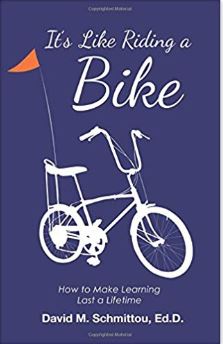
In 2017 my first book on educational methods, titled It’s Like Riding a Bike-How to make learning last a lifetime, was published. With more than 10,000 copies printed, I decided that now is the time to share my thoughts with the world for FREE.
Over ten weeks in the summer/fall of 2023 a chapter of the book will be shared each week via this blog. Feel free to read in any order that works for you. Feel free to bookmark entries to read all at once at a later date. Feel free to share with others. Feel free to disagree with anything you read or to scream your affirmations from the mountain tops. This is for YOU. This is for our kids. This is how we teach so that it lasts a lifetime.
Chapter 7
Step 7- Let them go and let them grow
This takes us to the seventh and final piece of the bike riding metaphor, it’s ok if they get better than you. Really, it is. You will never see me jumping curbs, riding no-handed, or asking my friends to jump on my pegs to go for a tandem ride on my bike, a large ten-speed mountain bike. Why, well for starters, I am not even sure I can do those things. You know who can though, my kids, who are thirty years younger than me.
Nowadays kids are exposed to stunt riders and trick riders all over the internet. They see these amazing athletes doing tricks I have never even imagined, and they want to duplicate them. Me, I am ok going for a nice Sunday afternoon ride to buy a newspaper. That is not good enough for them. My kids want to find some trails, find some hills to jump. They want to push their own limits. As a middle-aged man in America, I have my own comfort zone. I have a preferred upon method of bike riding. I have a preferred upon method for learning. I love to read. I love to take leisurely rides just as much as I love to read. My kids, not so much. As a dad I can sit my children down and tell them that they need to do things the same way as me or I can tell them that the sky’s the limit and they are free to pass me by. It’s ok if I am not comfortable with what they are doing. It’s ok if I sit on the sidelines and watch them do jumps and tricks that I never attempt as long as I don’t intern try to squash their enthusiasm for being better than me.
As a parent with four kids of various ages, I understand what it means to have children at a wide range of ability and cognitive levels. What I don’t understand is why we as adults try to classify ability levels into neat little boxes as much as we do. For example, my now ten-year-old son is a great bike rider. He hops on, jumps curbs, pops wheelies, and sometimes is caught going no-handed in spite of my cautions for him to stay safe. Now, I am a bike rider as well. On the weekends I can often be found riding my mountain bike with a toddler trailer being pulled behind. I do not do jumps nor do I ride no-handed. If someone were to evaluate my skills as a bike rider I would clearly be seen as proficient. I do not fall down and I don’t crash into cars or pedestrians. My ten-year-old son, however, definitely has more skills than I do or is at least a bigger risk-taker. If the two of us were to put on an exhibition for an evaluator, with my son going first would they classify him as riding at a ten-year-old level? Would this mean he is performing at a level comparable to his peers? What about me? I am three decades older than him. Should my goal be to be identified as riding at a ten-year-old level or at a cautious, yet proficient thirty-eight-year-old level? What would the requirements be to be identified as proficient? Is it based on balance, risk-taking, speed, ability to shift gears, apply the brakes, etc…? What is the most important feature? As a cautious rider I would argue, safety is the most important. My son would argue risk-taking. A professional rider may argue for speed or endurance. In schools, we constantly place labels on kids based on our subjective opinions of what they should be able to do. A child may be a third grader, with ADHD, reading at a first-grade level, but what does any of this mean and what do we do about it?
In my school, in my classrooms, just like in my house, I am ok if my kids don’t want to read. I want them to learn. I want them to grow. I want them to do more than I ever imagined possible. I want to help them do it by guiding them and supporting them and helping them appreciate that we are all different and that is OK. I love my kids. I love my job. I love to learn, and I want them all to know that, whether they read it, hear it, or feel it. Knowing it is all that matters.
As I am writing this, my kids are all home on Spring Break. My oldest, in 4th grade, has spent the last 120 days adjusting to the way school works in Florida. Last summer we moved to Florida from Michigan and I can state emphatically that schools in these two states are not the same. At his previous school, he was assessed three times a year on his reading ability and was always told that he was reading “above grade level”, whatever that means. The concept of being “at grade level” reminds me of the charts I get from the pediatrician letting me know that my children are all in the 90th percentile for weight and height. Does this mean I should worry that they will all grow to be giants, towering above all but 10% of their friends and family or should I just be concerned if they are an outlier in the other direction? Should these statistics only cause alarm if the majority of others are seemingly better off? Does having a son who reads “above his grade level” mean he is smarter than his peers? Does it mean he can learn more than his peers? If it were that simple then he probably wouldn’t need to bring home a report card outlining his performance in every subject area. After all, reading is all that matters and if he can read he will know more than those who can’t…right? Well, here in Florida he receives a report card every nine weeks which provides him with an aggregate grade for each core subject area. Last week he brought home a report card that showed a grade of C+ in Science, B- in Social Studies, A- in Math and an A in Reading. His lowest grade was in Science; his highest grade was in Reading. Let me complicate things here by stating that my son spends approximately eight hours a week watching the Science Channel on TV. He will bypass Nickelodeon and the Disney Channel when flipping through channels to instead watch Myth Busters or How It’s Made. As a result, he can explain how just about any common household object is made. He can explain how the universe is expanding, how planes can fly, and how El Nino impacts weather patterns across North America, yet he has his lowest grades in the subject area that he has the most interest and arguably the most knowledge. How is this possible?
I have a son who can pass a reading test, can demonstrate an understanding for complex phenomena, yet is assessed at a level that is less than prolific. When I met with his teacher a few weeks ago to try and get some insights into this I discovered that she had a thinking that is very similar to so many others. She was seeing learning as binary and not complex. In our meeting, we had the following conversation:
Me: “Mrs. F, I am hoping you can explain some of Cameron’s grades to me.”
Mrs. F: “Well, sure. He is a smart kid. If he would just work harder his grades would improve.”
Me: “Thank you for saying that. I hope I don’t come across rudely here, but how do you know he is smart?”
Mrs. F: “Well he knows so much. He participates in all our conversations and is always challenging the status quo.”
Me; “That’s great, but I am confused. Can you explain his grades?”
Mrs. F: “Sure. Our tests and assignments are all based off things we read in class. If he doesn’t read, he won’t do well. I have told him he needs to just read for about twenty minutes each night and he will do so much better.”
Me: “Oh. Thanks, however, he doesn’t learn through reading. He reads for fun. He spends his mornings watching the Science Channel and his afternoons with his brothers and sister or outside playing baseball with his peers. Which of these activities do you think he should give up so that he can start reading more?”
Mrs. F: “Well that’s not for me to say, but if he doesn’t start doing things the way everyone else does, his grades will stay the same.”
Me: “I am so sorry. I didn’t realize everyone else in the class had an A in every subject. I will adjust my son’s schedule today.”
Mrs. F: “Not every student has an A, but the good ones
do.”
Me: “I get it. My son is not one of the good ones. I have one request. Feel free to tell me I am crazy, but is it possible that you are defining ‘the good kids’ by looking for the kids who learn things the same way you do? Is it possible that some kids learn things in different ways and can then demonstrate their understanding in different ways? If so, as a teacher, is it possible that some kids will learn the same way you do and some will not and that it is your job to figure out how to reach every child?”
Mrs. F: “I have a class with more than twenty students. I cannot possibly figure out the unique ways every child learns. Sometimes I have to look for the ways that will reach the most kids and hope everyone can just follow along.”
Me: “I completely get it. Reading is a great way to communicate ideas to the masses. It is easy to send all kids home with a book and ask them to read so they can all learn the same information. I do get it. I just hope that my child can learn from a teacher who is willing to do whatever is necessary to move his learning forward, not just doing what is convenient and easiest.”
Right now I am sure many of you who are teachers are thinking one of two things, “Thank God his kids are not in my class” or “Thank God I don’t work in this guy’s school.” I know I can be intense. In my own school, I have often said the greatest gift I can give my teachers is the ability to defend their craft. If they can’t explain why they are doing what they are doing, they should stop immediately. We don’t allow kids to shrug responsibility for their actions by saying they don’t know why they do what they do. We should have at least that much of an expectation for our teachers. Teachers need to be willing to go beyond what is convenient and be able to argue for what is best. In order to argue for what is best, they must know what is best. They must be able to sit back at the end of the day and determine whether or not it was a good day at work or not. For a teacher, this means she should be able to know whether or not her students learned. If learning is dependent on reading, teachers could in theory just spend their planning time figuring out what textbook pages to assign. If kids show up and read what is assigned, they will learn, right? It’s all about the textbooks, right? Of course not. Teachers teach.
To teach, a teacher must identify what a kid knows, what they need to know, and then how they will learn it. We must get beyond telling students they simply need to try harder, study more, read more, and do what we do to learn and be successful. As adults, we must be willing to adjust our notions of what learning looks like and meet students where they are to move them forward. It seems like a daunting task, but rest assured, it is not as complex as you might think. Let me walk you through a few more metaphors and then guide you through how this works for you.
I get up at 4:30am each day. I start my morning with a jog usually running 25-30 miles a week. I spend 3-4 evenings a week lifting weights. I do not eat dessert and have at least five servings of fruit and vegetables each day. I am thirty-eight years old and weigh 167 pounds. I ask you now, am I healthy? Based on what you know can you draw a conclusion, and I am assuming most of you would say, “Yes”. What if I added the information that my grandfather on my dad’s side passed away at 42 years old from a heart attack and that my dad had his first heart attack five years ago at age 55? What if I told you that on my mom’s side cancer and depression are common and that my grandmother passed away while experiencing dementia? Does this information complicate your analysis of my health? How much information do you need before you can label me as healthy or unhealthy? Is my health relative to your own health or those around me? Does your own experiences and history impact your ability to analyze me?
The last time you went to the doctor for a well-visit checkup, what tests did the doctor run to determine your health? Quite possibly your height, weight, blood pressure, sight, and hearing were all measured. Perhaps some blood work was ordered and maybe even a few scans were completed. Your doctor recognizes that health is a complex determination. Your body is made up of numerous systems that all have an impact on your total health. Your doctor could assess every system in your body, every day if you wanted, but time and money often restrict us from such intrusive measures. Instead, your doctor may look at your history, run some simple tests, and then determine how to best follow up. Maybe he will order more labs, maybe he will give you a clean bill of health. Regardless of the result, your doctor will often take your results and either refer you to a specialist or offer some simple suggestions on how to improve your results next time and then ask you to come back at a future date so he can measure your progress. Rarely will a doctor simply state, “You are healthy” or “You are unhealthy.” He will typically share your results on a variety of measures and then compare your results to the norm and let you know how you compare. If your doctor is any good at all, he will not run his tests and then simply hold onto your records, or perhaps mail them to you two months later saying that you are either alive or almost dead. That would be ludicrous. We expect immediate feedback and guidance. Heath, like learning, is not binary. It is something that can be compared against a standard, assessed relative to others, and monitored over time. We would expect nothing less from our medical professionals. As educators, we must be willing to embrace the same mindset in our classrooms. We cannot label students as Special Ed. and therefore incapable of showing success, gifted, and capable of more than others, at grade level, below grade level, a C student, a problem student, an at-risk student, etc…. These labels, although convenient for compartmentalizing students are often counterproductive in helping us actually do our job, which is helping each individual child grow in their understanding of very specific learning targets.
Just like learning can come in a variety of ways, so too does our ability to assess it. Taking a multivitamin in the morning helps me stay healthy, but as I have recently learned, if my eating habits are well-rounded, a pill once a day to gain vitamins and minerals is not needed. It is one way to gain what I need, but not the only way. In our classrooms, our job is to create healthy learners, capable of getting healthier through a variety of methods. We cannot force one diet on all and expect every child to gain the same results. Walk into your local GNC and ask a sales rep for the one diet or nutritional supplement that works for everyone, and you will hear that there is no such miracle drug. We must understand the same is true in our classrooms. Reading is one way to gain knowledge and information. It may help me gain some wisdom, but it is not the only way. Taking my weight and blood pressure is important to gather baseline information, but far from a complete assessment of my health. A test in class this Friday assessing content knowledge or students’ reading levels, may be a good way to determine a limited scope of understanding, but does not paint a complete picture of knowledge or how to help it progress.
To read earlier chapters, visit https://schmittou.net
 Lasting Learning: Serving leaders, educators, and students.