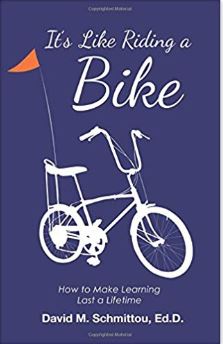
In 2017 my first book on educational methods, titled It’s Like Riding a Bike-How to make learning last a lifetime, was published. With more than 10,000 copies printed, I decided that now is the time to share my thoughts with the world for FREE.
Over ten weeks in the summer/fall of 2023 a chapter of the book will be shared each week via this blog. Feel free to read in any order that works for you. Feel free to bookmark entries to read all at once at a later date. Feel free to share with others. Feel free to disagree with anything you read or to scream your affirmations from the mountain tops. This is for YOU. This is for our kids. This is how we teach so that it lasts a lifetime.
Chapter 13
Life is full of tests
In America, we give a lot of attention to the jobs of doctors and lawyers. We encourage children to pursue these career paths, believing them to be truly professional roles, reaping big paychecks and society’s respect. Doctors and lawyers are among our most educated citizens and we as expect them to also carry with them a certain level of expertise as a result. We go into our doctor’s office and do not want to simply get a lecture on healthy living, we expect to have someone who has been trained on how to assess our health and then provide a patient-centric plan for improvement. We do not want lawyers who will simply take any case and tie up the legal system of time-wasting efforts, but instead desire to have an attorney who is capable of collecting evidence and drawing rational and logical cases as well as being able to then provide compelling visions of what the evidence says. Compare that to what we expect of teachers. What I have seen across the country is that most teachers are not given the training in how to assess, collect evidence, provide feedback on the evidence, or provide patient-centric plans. Districts tend to spend thousands of dollars providing teachers with binders and posters for their walls, textbooks for all kids, and training on how to implement the latest silver bullet plan. Teachers are not given the guidance afforded to other professionals to effectively do all aspects of their job and yet we wonder why our students are not progressing. If a doctor had the vast majority of his patients dying we would expect an audit not just of his treatment plans but of his plans for diagnosis. Why was he not catching the ailments and why was he not able to prevent further complications? We know that proper diagnosis leads to proper treatment. We wouldn’t expect the doctor to just be given more posters to line his office walls or more informational pamphlets for the patients to read in the lobby. For some reason though, this is exactly what we have done in America’s schools. I know this because I have a side job as an adjunct professor for a small college in its education department teaching courses on the use of assessment to drive instruction. My courses are all housed within the graduate program of the college I work for, meaning most of my students are already teachers. The courses are reserved for those pursuing an advanced degree or administrative credentials. Those on the front lines of educating our nation’s youth, our current classroom teachers are often given training from their undergraduate programs in their major discipline subject area, they may receive a little instruction on lesson planning, and pedagogical theory, but are left at a disadvantage when trying to understand how to gauge and measure student understanding of the concepts they are teaching and how to use that information to plan for future instruction.
Teachers must come to understand what standard measurements are, how to assess their students, and then how to create student-centric plans. Each of these components is essential. We cannot look at any of these components as independent silos. As teachers, we must gain a better understanding so that we can eventually begin to make informed, evaluative judgments and the creative dynamic lessons our students deserve. As teachers, each day we are forced to make decisions on instructional bias. We are asked to establish priorities and determine the importance of concepts based on our own subjective lens or objective data analysis. Just as this morning I was only able to only run three miles prior to work because I elected to sleep an additional fifteen minutes beyond my normal wake-up time and still wanted to show up at the office prior to being seen as tardy, I made decisions of value. I valued a little extra sleep. I valued a run over an extra cup of coffee. I valued punctuality over the extra mile on the streets in my jogging shoes.
In your classroom, you make selective decisions daily. What will you place on your bulletin board? Which students will you allow to sit next to each other? What Christmas cookies brought to you by students will you actually eat and which will you throw into the trash? We have heard before that teaching is both an art and a science. Being selective and making wise instructional decisions is the art of teaching. What separates a good artist from a hack is simply decision-making. A photographer decides which negative to develop and which to discard. A potter decides which pot to glaze and which to reshape. A painter decides which colors to combine and which to avoid. Effective teachers make similar artistic decisions. They embrace the science of teaching allowing them to quantify data, analyze standards, and evaluate curriculum, but they are artists because they can take scientific analysis and make decisions that allow them to change the destinies of their students in ways nobody else can. In the day and age we live which elevates the importance of standards we must also remember that artists are only seen as great when they are original and difficult to replicate. Artists understand essential standards of color, shape, size, contrast, and texture, yet taking accepted standards and creating something original is what leads to endurance and legacies. Teachers must be willing to take risks and think outside of their proverbial box to reach kids as only they can. Teachers teach. Everything else is simply a tool to help them do so, everything including the curriculum, the texts, the assessments, the supplies, the classroom, the …everything. Teachers must look at everything they are given and see it as a tool, not a mandate, and not a requirement for student success. But I’m getting ahead of myself. Just like a great artist can make decisions on quality only based on foundational knowledge of color, texture, shape, and dimension, teachers must first embrace the science of standards and quantifiable evidence before building on this foundation to make subjective interpretations of quality.
Regardless of where you live and which district you are employed in, if you are a teacher you are expected to help your students gain an understanding of selected standards. These standards are not up for debate as legislators and executives, often working at the state capital or in high-rise buildings far removed from your classroom, decided that students must be able to learn certain essential elements in order to be seen as successful at various levels. Your state may have adopted the Common Core State Standards, The Next Generation Science Standards, The C3 Social Studies Framework, or some other variation of standards that politicians got a hold of and adapted to meet their own political agendas. Regardless of which standards you are asked to teach your students, you are confronted with three realities: 1) There are far too many standards for you as a lone teacher with approximately 180 days of school this year to possibly get through 2) Every teacher in your building, district, state, and municipality interpret each of these standards differently, and 3) You are more than likely being evaluated in part, not just on your ability to “teach” the standards, but your students’ ability to prove that they have “learned” the standards.
As a teacher, it is becoming more commonplace for you to serve on a school data team where you may evaluate a state assessment and your students’ success, or probably more accurately, the students you taught last year and their success so that you can determine deficiencies and come up with a focused plan of attack to remedy those issues in future years. It is probably also true that at some point in the last three years, you were told that the format of your state-level test was changing. Maybe the students will now be tested online. Maybe they will be given an adaptive test that by nature students will be expected to get 50% of questions wrong on. Maybe the subject areas and grade levels for the assessment have changed. Maybe you teach a subject area in which there is no state exam and you have been asked to try and develop your own assessment criteria. You as a teacher, with very little formal training on test validity and reliability, little understanding of standard deviations, T scores, percentile rankings, evaluator bias, etc…have been asked to look at a collection of student scores, make sense of it, and make instructional decisions, of course with the guidance and support of a local administrator who probably had a graduate level course in all of this and has the three credit hours on his/her transcript to prove their expertise. As a building administrator, I am not knocking this process. As a matter of fact, I have had similar committees at work in every building I have worked in. What I am knocking is the belief that these teams have any lasting value to a teacher’s instructional decision-making. I am yet to meet a teacher who goes home at the end of a day in which they broke up a fight in the cafeteria, had fifteen parent e-mails to respond to, collected one hundred homework assignments to grade, and attended a grade level team meeting during their only forty-minute break of the day, and then on the drive home thought, “Wow, today was a good day because I know the median for my state achievement test scores increased by two points.”
As teachers, we see the whole picture, but we live the day-to-day. We need to be able to evaluate today and determine how it will impact our tomorrow. Teachers should be involved in the process of generating school improvement plans and looking at school-wide data, but this is not what drives the day-to-day. The best teachers look at individual students, their competence, and their confidence. They look at kids and measure their affect as well as their assessment effect.
I am a firm believer that we should be teaching to the test. What I am not a proponent of is teaching how to test. I have had parents approach me about their kids and tell me “My child is not a good test taker.” I have taken a look at teacher grade books and have seen some teachers who weight their grades so that tests have a larger impact on total success, or at least as measured by a grade than homework and classwork does. I have seen some students who never complete daily work but get A’s on every test or quiz. I have seen some teachers who never give paper and pencil exams but instead, give projects and presentations every few weeks. As teachers, we look at our systems and try to manipulate them to serve our own purposes. We value certain tasks and behaviors over others and allow our biases to impact how we assess and provide feedback to our students. When I say I think we should “teach to a test” I simply mean to begin with the end in mind. Test often carries with it a mental image of a quiet classroom with students all holding a number 2 pencil, carefully filling in small ovals, while a teacher sits behind her desk. This teacher is just waiting for a child to sneeze so that she can rush over and rip up the child’s work for obviously using a creative new code to cheat with their friend seated on the other side of the room.
In the real world in which we all live outside of the sterile confines of a classroom, a test has a much broader definition. I am tested daily by my four children. They may argue and fight begging for me to respond in an appropriate way to meet their needs. Often driving home, I am confronted with a reckless driver who may cut me off testing my driving skills and my patience. Life tests me daily and very rarely am I given a paper and pencil in which to prove my proficiency.
As educators, we are tasked with trying to prepare our students to be successful in the real world and as such, we need to test them as the real world does. We need to find ways to assess their skills, abilities, and attitudes that are authentic and meaningful. We need to make sure that we as educators are able to look at these tests and make informed artistic decisions that allow us to remediate and advance learning, not just label a child as successful or failing because of a singular moment in time in which they were given a two-sided worksheet to regurgitate a bunch of information presented to them in a week’s worth of lectures. As educators, we must understand what our tests will look like before we begin our instruction and then do all we can to make sure that our instruction is helping prepare our students for those tests, tests that may come in a variety of formats, at a variety of times, and in a variety of circumstances.
As a father, I know life is hard and filled with obstacles. I know my children will be asked to display patience and perseverance. I know they will be asked to be honest and confidential. I may not be able to predict when or how they will be asked to demonstrate these things, but I know the tests will be coming. As they grow up I am ever on the lookout for them to demonstrate how much of these attributes they have absorbed and retained so that I can provide reteaching or greater understanding. As a classroom teacher, I must do the same. I must first come to an understanding of what the test is, or at least what will be tested, and then make constant adjustments to my instruction to ensure that my students will be ready when tested. I am not going to focus all my attention on a specific format of a test but instead be sure that my students have a thorough understanding of the content so that no matter the format, they will be able to show success. My kids at home are learning that they should not just show respect to me as their dad when they are making a request for a new toy, but are learning what respect looks and sounds like to all people at all times so that no matter who is testing them or how they are being tested, they will be able to demonstrate an understanding, and if not, as their dad, I can step in, intervene and do some reteaching.
In your classroom, it is imperative that you as the teacher gain clarity on what needs to be taught and that your students learn these skills with such depth that no matter the formatting of a future test, they can show understanding. We need to move beyond the days of asking students to study on a Thursday for an exam on Friday so that it can all be forgotten on Monday. We need to begin asking ourselves, if this is not important enough for a child to remember beyond my classroom, should I be spending time in my classroom teaching it? If the only guidance I can give a student to learn more is to study more, am I really needed? As a teacher, you must get yourself comfortable thinking of yourself as the single most important item needed in your student’s academic life. You are the one who not only determines how items will be taught, but what will be taught.
You have tremendous control over each child’s destiny. Research has proven time and again, that far beyond the curriculum, pedagogical tricks, and scheduling frameworks, the single greatest factor in determining a child’s academic success or failure is a high-quality teacher. That is a huge responsibility. As a teacher, you can either run away from that responsibility and say you don’t want it and leave it up to textbook manufacturers and career politicians to help chart a young child’s destiny, or you can embrace it and use your knowledge to help change the future. You must be willing to move beyond simply reading the standards, looking at quantitative data analysis and the accompanying pacing guide, to begin to really embrace the art of teaching. Just as learning requires more than just decoding text on a written page, teaching requires far more than facilitating students to complete tasks. Teaching requires the ability to allow students to learn and every child will learn differently.
That sounds great, but do teachers really have the power to decide what to teach their students? After all, who are you to decide what is the most important thing for a child to learn and how they are to learn it? You are the TEACHER; that’s who. Now don’t get me wrong. I am not asking anyone to work outside of the system currently in place. I am not asking for mutiny and anarchy while every teacher subjectively decides what the most important concepts and subjects are and tosses the rest to the side. That is what we have had for the last fifty years when every elementary teacher taught dinosaurs and every secondary English teacher taught the parts of speech. Teachers cannot just subjectively decide what is interesting or important. I am not asking you to disregard the system but to study the system in place, determine which fights are essential, and then work within the current system to change it.
For example, in my current district, fourth-grade teachers are presented with seventy-seven English Language Arts standards for their students. More than simply learning the standards, students are expected to be able to demonstrate mastery of them by the end of the year. If it were simply about teaching them a teacher could take one day out of the year, stand in front of her students, and read the curriculum framework aloud. Reading the seventy standards word for word could probably be accomplished in one ninety-minute assembly or two forty-five-minute class periods. Haven’t we all had a teacher who thought their job was to stand behind a podium in the front of the classroom and lecture for a full class period, seemingly never even pausing for air? Maybe they are really innovative and have a PowerPoint with all their words and a few associated pictures and graphics to go along with their speech. Maybe they even ask students to take notes, aka, copy their every word. None of us would do that though, because we know teaching goes beyond just speaking. Like leading requires followers, teaching requires learners. If students are not learning what is being presented, then no teaching is taking place.
Knowing that a teacher will not be able to simply stand in front of her students and read the standards, how will she be able to ensure all of her students have mastered all of the standards before she sends them off to the next grade level? She could take the 180 days in the school year and divide the seventy-seven standards evenly and every 2.337 days introduce a new standard to the students. She could then wait until the state-mandated spring assessment is given and place her students in front of the test and have full confidence that they will all show mastery of every standard. In Florida, like in the majority of states today, teachers have their professional evaluations tied to their student performance on these end-of-the-year tests, so they would be foolish not to do all they can to help their students show success. Even if a teacher is not altruistic enough to believe his job changes a child’s life, he should still understand that his own job appraisal may depend on his ability to get students to show success on the end-of-course test. So why is it that this strategy of quickly covering every standard in a predetermined time frame isn’t advocated by anyone other than textbook companies? As a matter of fact, a quick review of current research on the most effective instructional practices argues for the exact opposite. If you don’t believe me, take another break from reading this and do a quick Google search for teaching effect size. You will see the most successful approaches are those that allow for greater student voice and control, translated for us, that means less teacher control.
As teachers who are concerned about our evaluations and with the moral imperative to help every child grow in a meaningful way, why are we content to let textbook publishers, our greatest competition, determine how to best educate our kids. We need to be willing to take a stand for what we know is best for our kids. Teachers teach. Students learn. In our schools, we have let our resources determine our future. Our books, our supplies, and our technologies are all resources. They are designed to help teachers, not to control or constrain teachers. These are all clothes in our proverbial closet to help us dress up our teaching. If something doesn’t fit you it doesn’t mean it won’t fit someone else; it simply means you may need to try on something different for you. Sometimes we need to just reach for our comfy jeans and T-shirt. Sometimes we need to wake up early and iron out what we are putting on. Sometimes we need to stand in front of a mirror and reflect on how we are presenting ourselves. One size, one fashion, does not fit all. We need to move beyond believing anything other than that. Teaching is hard work, but it is also extremely rewarding if done right. We need to realize that fashion comes and goes and that what fit last year may not fit this year, but we won’t know until we try it on. We must get accustomed to identifying what we need to wear, how to check the proverbial weather forecast and dress code, and then how to measure for the best fit. We can tell teachers every day to reflect and be student-centered, to differentiate their instruction and plan with the end in mind, but unless we teach teachers how to do this we may still be wearing the clothes and teaching the lessons that worked for us twenty years ago.
Teachers must embrace their power and responsibility along with the obligation of intentional planning. Teachers do not simply say something to kids one time, or in this case, repeat a standard over and over again for 2.337 days, and expect every child to learn it. That is not how it works. The reality is that teachers often resort to one of two approaches: they will either shrug off the responsibility of making instructional decisions because it is above their pay grade and beyond their control and resort to following a textbook page for page and ultimately limiting the positive impact a great teacher could have on a child’s success or they begin picking and choosing standards to teach based on their own interests or the exciting projects they can get the kids to make as a result.
As a classroom teacher, I was guilty of both approaches. Some days (months) I was just too tired to make lesson plans and would ask my students to read a textbook and answer the questions at the end of every section just so that I could have some grades to enter into the grade book or I would look around for fun project ideas (today it would be a Pinterest or Twitter search) and then go backward and identify what standards I could possibly connect to the cool poster project I discovered the night before. It was a rare day that I would sit down, analyze the standards predetermined for my grade and subject area, evaluate their relevance and impact, rank order them, and then determine which one to teach tomorrow and then how to teach it for the greatest impact. That was something I never did. Yet this is exactly what I should have been doing. I sure wish someone would have written this book for me back then…or since I didn’t read educational books back then, I wish someone else would have read it and explained it to me, because, after all, I don’t care about reading. Here is a brief overview that you can use to share with others who may not have the time or desire to read the first 100 +pages of this book.
Step 1- Embrace the concept that learning happens in a variety of ways, is not dependent on reading…or any other individual skill, and that it is a process, not a binary yes/no mechanical phenomenon.
Step 2- Embrace the power and impact of the classroom teacher. Understand that the art of teaching is critical, but it cannot be fully utilized unless the science of teaching is first explored.
Step 3- Use your innate instructional bias to make decisions that have a positive impact on your classroom culture, student engagement, and student achievement (keep reading to learn more about this).
Teachers sometimes struggle to embrace their power. We are used to having classrooms of kids look up at us from their desks presuming that we are the smartest ones in the rooms, yet for some reason we often still struggle to embrace the influence we really have. We are such rule followers that often embracing our ability to think for ourselves is a real struggle. As a building leader, I spend the bulk of my time trying to create a sense of bold humility in teachers. Bold humility is the unique character trait that I believe separates the great from the good. It is that “it” factor that we often talk about when we find a teacher who has mastered her craft. These individuals are bold enough to say they are the most important factor in changing a kid’s life, yet humble enough to realize that their own opinions may not always be right. They have confidence in their influence, but humility in their actions. In my schools, these teachers are embraced as change agents for the school as a whole and given individualized coaching on how to make decisions of instructional bias. I foster and encourage their ability to make decisions. I want them to embrace their power so that they can try to harness it for good. Teachers are superheroes who must understand their influence so that they can maximize it for the good of kids. A superpower not properly harnessed can be a destructive force, a hurricane, or a supervillain. Power embraced and used for good can change the world the good. These teachers are afforded the opportunity to use their power to analyze the academic standards assigned to their subject areas and grade levels to make decisions of priority to help change kids’ lives one lesson at a time.
Soon after teachers begin to realize their power and influence, they are asked to begin making some decisions. Before teachers start deciding how they are going to teach (the art of teaching) they are asked to examine what to teach (the science of teaching). In my schools, we use the term Power Standards to describe those standards that we believe are the most essential for student success. In other schools, I have heard them referred to as Essential Learnings, Priority Standards, or even Must Knows. These are the standards that the teachers have determined are the most critical of all standards.
Knowing, for example, that there is not enough time in a school year to teach each of the seventy-seven ELA standards in a fourth-grade classroom to the depth required for every student to gain mastery, these are the standards that classroom teachers determine to be the most powerful. In some districts, these standards are chosen by looking at state assessments and picking the standards that are tied to the most questions on the standardized exam. In some districts, these standards are chosen by asking teachers which standards they enjoy teaching the most. In my buildings, we ask which standards a teacher is willing to stake their career on. We are not looking to add to our list of available standards, but instead, we look at those given to us and determine which have the most value. Which standards do we want our students to understand beyond any single test? Which carries the most leverage allowing for students to take that foundational knowledge and apply it across disciplines? Which standards are deep and meaningful?
In order to make these decisions as an educator one first needs to gain a greater understanding of what the standards actually mean. Teachers can’t just read through the complex verbiage of the standards and make a gut-level decision. Standards not only show what content needs to be introduced but also to what depth. Standards, as they are written now go beyond stating the content to be addressed, but now are commonly written as what the students will be expected to do with the content. The standards not only show the knowledge students must be able to recall, but what they should be able to analyze, evaluate, or create. Using the framework of Bloom’s Taxonomy an educator can do a quick analysis of the standards and determine which carry the obligation of high-order thinking. Which standards ask students to do more than memorize facts. Memorizing facts is something a student can do independently and probably does not require a teacher to devote her sacred and limited time to. Gaining basic knowledge of a concept is something that can be done by reading a book or completing a worksheet. Standards that require a highly competent, life-changing, inspired teacher, are those that require greater depth and in turn are those that are the most essential for the classroom teacher to address. Teachers must analyze each of their standards to determine what verb is being used or what skill kids will have to demonstrate in order to prove mastery. If the standard asks students to simply “recall” or “retell”, teachers may choose to have a quick mention of the topic but will not devote to spending their artistic energies focusing on it. If however, kids are asked to analyze, evaluate, or create, teachers may want to narrow their focus a little bit and make this standard one of their priorities.
Teachers can then take their 70+ standards and place them into buckets based on their complexity. This may only mean that teachers are able to move standards into two categories “high order” and “low order” but they have been given a head start in determining what standards may be more critical. Even if the list of essential standards is reduced to only thirty-five relatively high-order standards, teachers may still be overwhelmed. Teaching one standard per week to a mastery level is only slightly better than one every 2.3 days. Somehow this needs to be reduced even further or teachers will fall into the trap of teaching Monday-Thursday and giving a test on Friday simply to label success or failure and moving on to new content every Monday. This is exactly what is done in so many classrooms today and it is not working.
Read earlier chapters by visiting https://schmittou.net
 Lasting Learning: Serving leaders, educators, and students.